
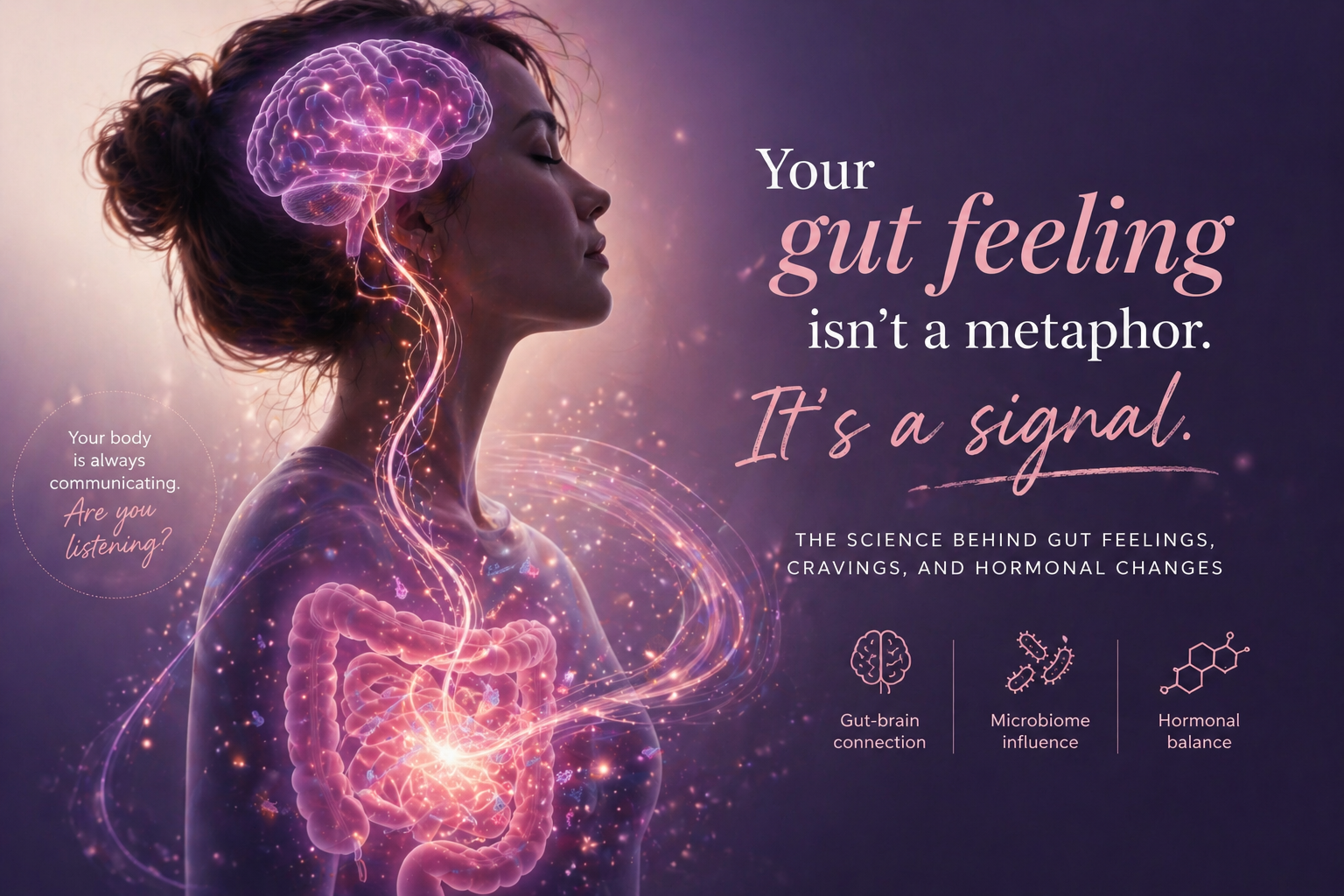
Your Gut Feeling Isn’t a Metaphor. It’s a Signal.
Your Gut Feeling Isn’t a Metaphor. It’s a Signal.

The Science Behind Gut Feelings, Cravings, and Hormonal Changes
Most people use the phrase “gut feeling” without thinking much about it.
A sense that something is off.
A sudden loss of appetite before a stressful conversation.
A strong craving that seems to come out of nowhere.
It’s often described as instinct.
But there is a biological system behind it—one that involves your nervous system, your gut bacteria, and your hormones.
Understanding that system changes how you interpret these signals—and what you do about them.
Your Gut Has Its Own Nervous System
Your digestive system contains over 500 million nerve cells.
This network is called the enteric nervous system, often referred to as the body’s “second brain.”
It communicates directly with your brain through the vagus nerve.
This is why your body often reacts before you’ve had time to think.
You may notice:
Tightness in your stomach around certain people
Nausea before a high-pressure situation
Loss of appetite during stress
These are not vague sensations.
They are neurological signals coming from the gut.
The Gut-Brain Connection Affects Mood and Behavior
Your gut plays a direct role in producing neurotransmitters like serotonin.
These chemicals influence:
Mood
Stress response
Sleep
Emotional regulation
This is why gut health and mental clarity are closely connected.
When the gut environment shifts, it can change how you feel—both physically and mentally.
Your Gut Bacteria Influence Cravings
Your gut is home to trillions of bacteria, known as the gut microbiome.
These bacteria are active participants in your physiology.
Some thrive on sugar and processed foods.
When they become more dominant, they can increase cravings for those same foods.
This is one reason cravings can feel strong and persistent.
It is not simply about willpower.
It reflects what is happening inside your gut.
Hormones and Gut Health Are Closely Linked
Hormones—especially estrogen and progesterone—play a key role in gut function.
Estrogen helps support a healthy and diverse microbiome.
Progesterone affects how quickly food moves through the digestive tract.
During perimenopause and menopause, these hormonal shifts can lead to:
Changes in digestion
Increased bloating
New or stronger cravings
Shifts in mood and energy
Many women notice these changes but don’t connect them back to the gut.
Why Gut Feelings Can Change Over Time
A gut feeling is a real signal.
But the clarity of that signal depends on the condition of your system.
When gut health is stable:
Signals tend to be more consistent
Reactions are easier to interpret
When the gut is imbalanced:
Cravings can become more intense
Signals may feel confusing or exaggerated
Mood and physical symptoms may fluctuate more
This is where many women start to feel like their body is unpredictable.
In reality, the system has changed.
How to Start Supporting Your Gut
Improving gut health doesn’t require extreme changes, but it does require consistency.
Focus on:
Regular meals with adequate protein and fiber
Reducing highly processed foods and excess sugar
Prioritizing sleep
Managing ongoing stress
Identifying underlying gut imbalances when symptoms persist
Small changes in this system can significantly shift how you feel day to day.
When to Look Deeper
If you’re experiencing:
Persistent bloating or digestive discomfort
Strong or frequent cravings
Changes in mood, sleep, or energy
New symptoms during perimenopause or menopause
It may be time to look beyond surface-level solutions.
These patterns are often connected and they are treatable when you address the root cause.
Work With Me
This is the work I do with my patients every day.
We don’t just look at symptoms in isolation.
We look at how the gut, hormones, and nervous system are interacting and where the imbalance is starting.
From there, we create a targeted plan to restore function, not just manage symptoms.
If your body has been sending signals you don’t fully understand, there is a reason.
You can learn to interpret them and improve them.
If this resonates with you, there are a few ways to go deeper depending on where you are:
Join my free community
This is where I share practical education on hormones, gut health, and how these systems connect—so you can start understanding your body in a clearer way.
Book a free call with me
If you want to talk through your symptoms and see what might be driving them, we can map out the next steps together.
Explore my services
For a more structured approach, I offer personalized care focused on restoring gut health, balancing hormones, and improving how your body functions as a whole.
You don’t have to guess what your body is trying to tell you.
Once you understand the system, the signals start to make sense.