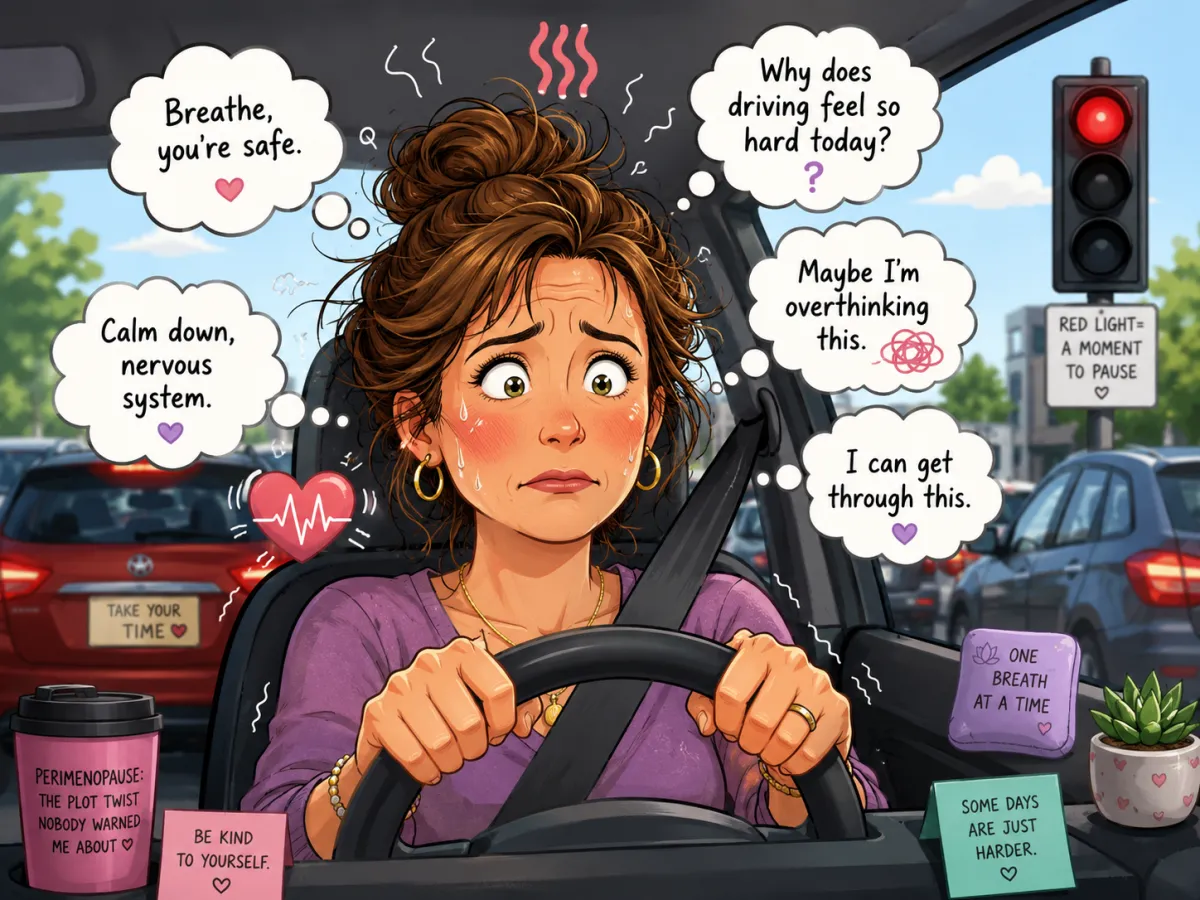
Driving Anxiety in Perimenopause: When Your Nervous System Needs to Calm Down
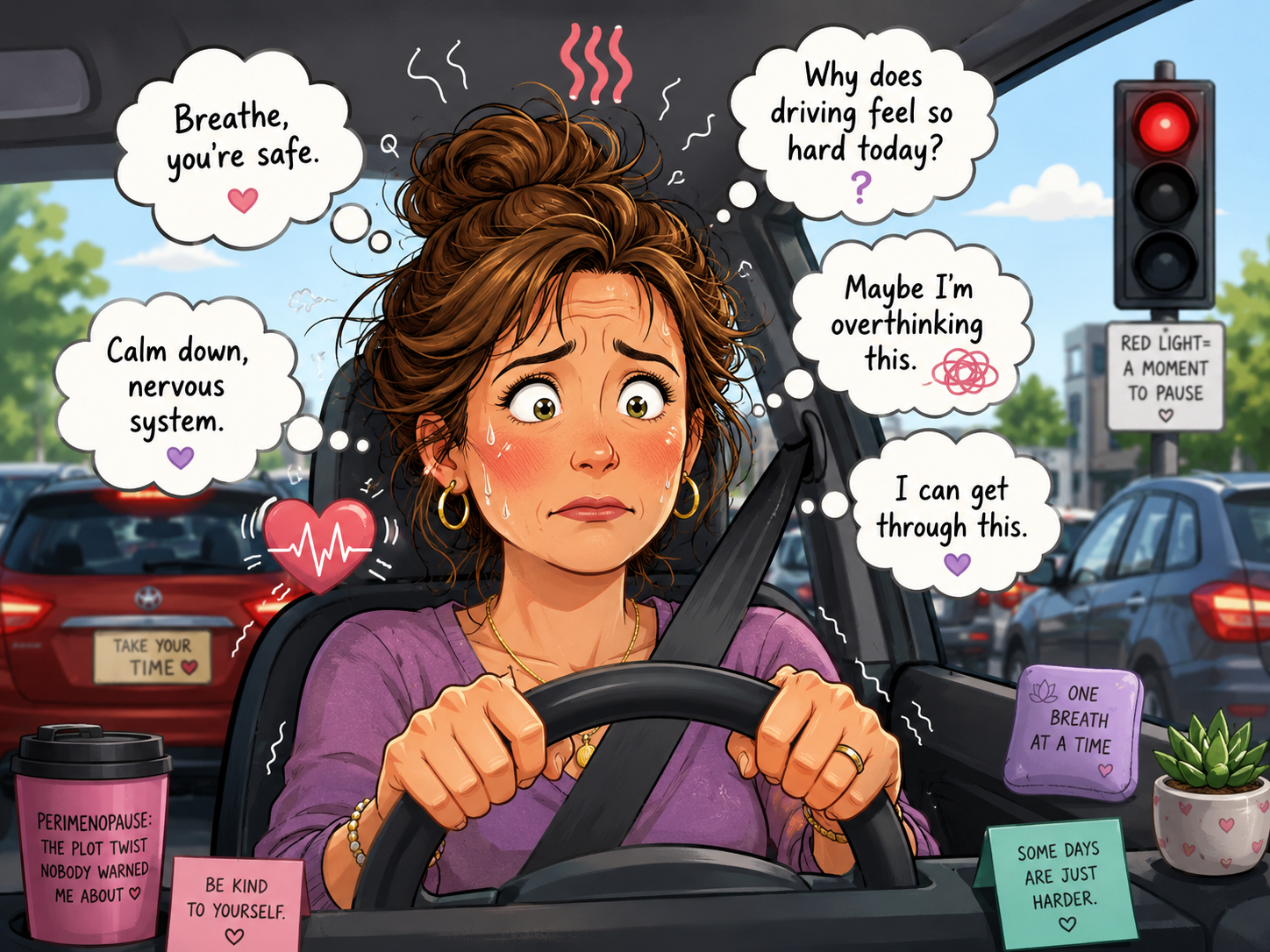
You used to drive everywhere without thinking twice.
Highways? Fine.
Bridges? Fine.
School drop-off, Target runs, appointments, errands, drive-through coffee? All handled.
Then perimenopause enters the chat, and suddenly your body is acting like merging onto the highway is the opening scene of a disaster movie.
Your heart races.
Your hands sweat.
Your chest feels tight.
Your brain says, “What if I pass out?”
Your body says, “We are not safe.”
And your rational mind is sitting there like, “Ma’am, we are literally just trying to go to Costco.”
If this has happened to you, you are not alone. Driving anxiety can show up or worsen during perimenopause, even in women who used to be confident drivers.
And no, this does not mean you are weak, dramatic, or suddenly bad at driving.
It may mean your hormones, nervous system, sleep, blood sugar, stress response, and brain chemistry are all having a very chaotic group text.
In other words, your internal Taylor Swift era may have shifted from “Fearless” to “Anti-Hero” overnight.
It’s you, hi, you’re not the problem exactly.
But your nervous system may be acting like it is.
Welcome back to the hormonal kingdom
In the royal hormone kingdom, estrogen has long been one of the elegant queens of the palace.
She helps support mood, temperature regulation, sleep, skin, vaginal health, brain function, and the delicate chemistry that helps you feel steady in your body.
Progesterone is more like the calm royal advisor. She helps support relaxation, sleep, and that “I can handle this” feeling.
Then perimenopause arrives.
The castle doors fly open.
Estrogen starts becoming unpredictable. Some days she is hosting a royal banquet. Other days she is missing entirely and nobody knows where she went.
Progesterone becomes quieter, especially as ovulation becomes less consistent.
Cortisol, the stress hormone, sees the confusion and decides this is his moment to take over the throne.
The nervous system guards become hypervigilant.
The brain’s fear center starts ringing bells for no reason.
And suddenly, your peaceful drive to the grocery store feels like a medieval battle scene with cup holders.
That is the hormonal kingdom of perimenopause.
Dramatic? Yes.
Accurate? Also yes.
Why can perimenopause trigger driving anxiety?
Driving anxiety in perimenopause is not “all in your head.”
It is in your brain, hormones, nervous system, sleep, blood sugar, vestibular system, and stress response.
Which is technically your head, but not in the dismissive way people mean when they say that.
During perimenopause, estrogen and progesterone fluctuate. These hormones influence neurotransmitters such as serotonin and GABA, which help regulate mood, calm, emotional resilience, and the body’s threat response.
When those hormones fluctuate, the brain can become more sensitive to stress.
Tasks that used to feel ordinary may suddenly feel threatening.
Driving is a perfect storm because it requires focus, visual processing, balance, quick decision-making, spatial awareness, confidence, and nervous system regulation.
If your internal system is already dysregulated, the car can become the place where your body finally says, “Absolutely not.”
The amygdala: the palace alarm system
Your amygdala is the part of the brain that helps detect danger.
In a well-regulated kingdom, the amygdala is like a wise palace guard.
It says, “That is a real threat. Pay attention.”
But in perimenopause, the guard may become overworked, under-slept, and slightly unhinged.
Now the guard is yelling:
“Highway? Threat.”
“Bridge? Threat.”
“Left turn across traffic? Threat.”
“Someone honked three lanes away? We may not survive.”
“Parallel parking? Prepare the royal will.”
This is not because you are weak.
It is because your nervous system may be interpreting normal driving sensations as danger signals.
Once the body has one panic-like episode while driving, the brain may remember it and start associating driving with fear.
Now the car itself becomes the trigger.
Rude, but common.
Estrogen, serotonin, and the feeling of safety
Estrogen helps interact with serotonin pathways, and serotonin helps regulate mood, calm, and emotional stability.
When estrogen fluctuates, some women become more vulnerable to anxiety, irritability, low mood, intrusive thoughts, or panic sensations.
This may be why a woman who has handled stress well for decades suddenly thinks, “Why do I feel like I cannot trust my own body?”
It is not a personality failure.
It is a biochemical shift.
In the hormonal kingdom, estrogen is not just wearing a crown and looking pretty. She is helping keep the palace lights on, the music calm, and the royal guards from overreacting to every sound.
When she becomes inconsistent, the whole palace gets jumpy.
Progesterone and GABA: the missing calm advisor
Progesterone has calming effects for many women because some of its metabolites interact with GABA receptors.
GABA is one of the brain’s calming neurotransmitters. It is like the royal advisor who walks into a chaotic council meeting and says, “Everyone sit down. No one is invading. Drink some tea.”
But in perimenopause, ovulation becomes less predictable.
Less consistent ovulation often means less consistent progesterone.
So the calming advisor may be showing up late, leaving early, or sending vague emails from another kingdom.
Without that steadying effect, some women feel more wired, restless, reactive, or panicky.
And then they get behind the wheel and wonder why driving suddenly feels like a full-contact sport.
Hot flashes, dizziness, and the panic confusion
Perimenopause can cause hot flashes, night sweats, palpitations, dizziness, sleep disruption, and adrenaline surges.
The problem is that some of these symptoms feel very similar to panic.
A hot flash in the car can feel like danger.
A palpitation at a stoplight can feel like a heart problem.
A wave of dizziness on the highway can feel like loss of control.
A sudden internal heat surge can make your brain say, “Something is wrong. Abort mission.”
The body may not know whether it is having a hormone surge, a panic attack, low blood sugar, poor sleep aftermath, dehydration, or all of the above.
So it files everything under: emergency.
Very organized. Completely unhelpful.
Why driving is such a common place for anxiety to show up
Driving makes you feel trapped.
Even if you are technically free, your brain may interpret the car as a place where escape is not easy.
You cannot simply lie down.
You cannot walk away mid-highway.
You cannot close your eyes and meditate, which is generally frowned upon at 65 miles per hour.
You have to keep functioning while your body is yelling at you.
That trapped feeling can amplify anxiety.
Then avoidance begins.
First you avoid highways.
Then bridges.
Then left turns.
Then driving alone.
Then driving at night.
Then suddenly your world gets smaller, not because you are incapable, but because your nervous system has become overly protective.
The goal is not to shame avoidance. Avoidance makes sense when something feels scary.
But long term, the goal is to gently rebuild trust with your body.
Symptoms women may notice
Driving anxiety in perimenopause may feel like:
Sudden panic while driving
Fear of highways, bridges, tunnels, traffic, or being far from home
Heart racing or palpitations
Sweating or hot flashes in the car
Dizziness or lightheadedness
Feeling unreal or disconnected
Tight chest or shortness of breath
Tingling in hands or face
Fear of passing out
Fear of losing control
Feeling trapped at red lights or in traffic
Avoiding certain routes
Needing someone else to drive
Feeling embarrassed because “I used to be fine”
That last one matters.
Many women feel ashamed because driving used to be easy. But bodies change. Hormones change. Nervous systems change. Shame does not help the healing process.
First, rule out medical causes
Before blaming everything on perimenopause, we have to be thoughtful.
New anxiety, palpitations, dizziness, shortness of breath, chest pressure, fainting, or neurological symptoms should be medically evaluated.
Depending on the symptoms, it may be appropriate to check for:
Thyroid dysfunction
Anemia or low ferritin
B12 deficiency
Vitamin D deficiency
Blood sugar swings
Medication side effects
Arrhythmias
Blood pressure changes
Vestibular issues
Migraine variants
Sleep apnea
Panic disorder or generalized anxiety disorder
Perimenopause can be part of the story, but it should not become a blindfold.
If your body is sending alarms, we do not simply yell, “Hormones!” from across the room and move on.
We investigate.
The Taylor Swift Version: You Need to Calm Down, But With Labs
In perimenopause, your body may feel like it is playing three Taylor Swift songs at the same time.
Your amygdala is singing “Anti-Hero,” convinced every highway ramp is the problem.
Your hot flashes are screaming “Look What You Made Me Do” every time the car gets slightly warm.
Your shaky hands and racing heart are trying to “Shake It Off,” but not in a fun concert way. More in a “why am I sweating at a red light?” way.
And somewhere in the background, your rational brain is gently whispering, “You Need to Calm Down.”
But here is the important part: calming down is not always just a mindset.
Sometimes your body cannot calm down because something underneath is dysregulated.
Maybe your estrogen is fluctuating.
Maybe progesterone, the calming royal advisor, has stopped showing up reliably.
Maybe cortisol has taken over the hormonal kingdom and is now making announcements from the balcony.
Maybe blood sugar is dropping because you had coffee for breakfast and called it a meal.
Maybe your thyroid is overstimulated or underperforming.
Maybe low iron, low B12, poor sleep, inflammation, or hot flashes are making your nervous system more reactive.
So yes, we want the nervous system to calm down.
But functional medicine asks: why is it so activated in the first place?
That is where the deeper work begins.
How functional health helps
Functional health asks a better question than “How do we suppress this symptom?”
It asks, “Why is the nervous system so reactive right now?”
In the hormonal kingdom, functional health is like calling a royal council meeting.
We check on the queen estrogen.
We ask where progesterone went.
We tell cortisol to stop sitting on everyone’s paperwork.
We inspect the blood sugar pantry.
We check whether the thyroid has been ignored.
We ask why the sleep guards are exhausted.
We look at gut health, inflammation, nutrient status, and nervous system regulation.
Then we create a plan.
Not a panic plan.
A physiology plan.
Functional testing that may help
Functional testing is not about ordering every lab available because someone on the internet said “root cause.”
Testing should be targeted and clinically useful.
Depending on the woman’s symptoms, history, and risk factors, evaluation may include:
Thyroid testing, including TSH, free T4, free T3, and thyroid antibodies when appropriate. Thyroid imbalance can mimic or worsen anxiety, palpitations, heat intolerance, fatigue, and mood changes.
Iron and ferritin. Low iron stores can contribute to fatigue, shortness of breath, dizziness, restless legs, palpitations, and anxiety-like symptoms.
B12 and folate. These nutrients matter for nerve function, mood, energy, and brain health.
Vitamin D. Low vitamin D may affect immune function, mood, inflammation, and overall health.
Metabolic testing, including fasting glucose, fasting insulin, hemoglobin A1c, and sometimes a continuous glucose monitor. Blood sugar dips and spikes can feel like anxiety, especially while driving.
Cortisol rhythm or stress physiology assessment when appropriate. This can help identify patterns of overactivation, poor recovery, or disrupted sleep-wake rhythm.
Sex hormone evaluation, interpreted carefully. In perimenopause, hormones fluctuate, so one normal estrogen or progesterone level does not always tell the whole story. Symptoms and cycle pattern matter.
Inflammation markers, when clinically appropriate.
Gut health evaluation, especially if anxiety is accompanied by bloating, constipation, diarrhea, reflux, food reactions, or suspected malabsorption.
Sleep assessment. Poor sleep can make the nervous system far more reactive. If snoring, morning headaches, daytime sleepiness, or nighttime panic are present, sleep apnea should be considered.
The point is not to make anxiety complicated.
The point is to stop pretending anxiety is only a mindset issue.
Sometimes the kingdom is anxious because the foundation is unstable.
Blood sugar: the hidden driving-anxiety trigger
Blood sugar swings are one of the most overlooked anxiety triggers.
If you get in the car after coffee and no breakfast, your body may interpret the blood sugar drop as danger.
Symptoms can include shakiness, sweating, palpitations, irritability, nausea, dizziness, and a sudden feeling of panic.
Sound familiar?
That is why some women say, “I only panic when I drive in the morning,” or “It happens when I have not eaten,” or “It is worse after coffee.”
Your nervous system may not be asking for a motivational quote.
It may be asking for protein.
Before driving, especially if you are prone to symptoms, try eating a balanced meal or snack with protein, healthy fat, and fiber.
Not a lonely cracker.
Not coffee wearing a breakfast costume.
Actual food.
Caffeine: the royal troublemaker
I know. Nobody wants to talk about caffeine.
Coffee is not just a beverage. For many women, it is a personality support device.
But in perimenopause, caffeine may hit differently.
If your nervous system is already sensitive, caffeine can worsen palpitations, jitters, hot flashes, reflux, sleep disruption, and anxiety.
This does not mean every woman must break up with coffee.
But it may mean your old coffee routine needs a performance review.
Try reducing the dose, avoiding coffee on an empty stomach, switching to half-caf, adding protein before caffeine, or moving caffeine earlier in the day.
The kingdom does not need six espresso shots and a cortisol parade before 9 a.m.
Sleep: the nervous system reset button
Poor sleep is one of the biggest anxiety amplifiers.
During perimenopause, sleep may be disrupted by night sweats, hot flashes, progesterone changes, stress, alcohol, blood sugar swings, or sleep apnea.
When you are sleep deprived, the amygdala becomes more reactive and the prefrontal cortex, the rational decision-making part of the brain, becomes less effective.
Translation: the palace alarm system gets louder, and the wise royal advisor takes a sick day.
A functional plan for driving anxiety must include sleep.
Not because sleep fixes everything, but because poor sleep makes everything harder.
Nervous system tools for driving anxiety
When driving anxiety happens, you need tools that work in real life.
Not a 45-minute meditation in the middle of traffic.
Try these:
Before driving, eat protein, hydrate, and avoid rushing.
Choose a familiar route at first.
Use calming music or silence, depending on what helps.
Keep the car cool if heat triggers symptoms.
Practice slow exhalation breathing before you start driving.
Name what is happening: “This is my nervous system. It feels uncomfortable, but it is not dangerous.”
Use grounding: feel your hands on the wheel, feet on the floor, back against the seat.
Start with short, repeated drives to rebuild confidence.
Avoid making your world smaller too quickly.
If panic is severe, consider working with a therapist trained in CBT, exposure therapy, or panic disorder support.
The goal is to teach the brain: driving is safe again.
Not all at once.
Gently. Repeatedly. With support.
Can hormone therapy help?
For some women, hormone therapy may help anxiety symptoms, especially when anxiety appears alongside hot flashes, night sweats, sleep disruption, and other perimenopausal symptoms.
But HRT is not a universal anxiety treatment.
The decision should be individualized based on symptoms, age, time since menopause, personal and family history, risk factors, and treatment goals.
Some women may benefit from HRT.
Some may need nonhormonal options.
Some may need therapy, SSRIs or SNRIs, thyroid support, blood sugar regulation, sleep treatment, or a combination approach.
In the hormonal kingdom, HRT can be a powerful royal advisor.
But it is not the only advisor.
And it should not be appointed without reviewing the whole kingdom.
How functional medicine helps you “shake it off”
Functional medicine does not look at driving anxiety and say, “Just breathe.”
Breathing can help, but if your body is running on caffeine, poor sleep, low iron, unstable blood sugar, thyroid imbalance, and perimenopausal hormone swings, breathing alone may feel like trying to fix a flat tire with a scented candle.
A functional approach looks at the whole hormonal kingdom.
We ask:
Is estrogen fluctuating and making the brain more sensitive to stress?
Is progesterone low because ovulation is becoming irregular?
Is cortisol running the palace like an overworked manager with no boundaries?
Is blood sugar crashing and making your body feel panicky?
Is caffeine making palpitations and anxiety worse?
Is the thyroid contributing to shakiness, heat intolerance, or racing heart?
Are iron, ferritin, B12, vitamin D, magnesium, or other nutrients low?
Is poor sleep making the brain’s alarm system louder?
Are hot flashes or dizziness triggering fear while driving?
Is your nervous system stuck in high alert?
The goal is not to shame the anxiety.
The goal is to understand it.
Because once we understand the pattern, we can create a plan.
That plan may include stabilizing blood sugar, reducing caffeine, improving sleep, correcting nutrient deficiencies, supporting thyroid health, addressing hot flashes, using nervous system retraining, considering therapy such as CBT or exposure therapy, and discussing hormone therapy or nonhormonal medication options when appropriate.
Functional medicine helps you stop guessing.
It helps your body learn that the car is not a battlefield, the highway is not a villain, and the left turn lane is not a personal attack.
What a functional plan may include
A comprehensive plan may include:
Clarifying whether symptoms are anxiety, panic, hot flashes, hypoglycemia, vestibular symptoms, thyroid changes, or a mix
Checking targeted labs when appropriate
Supporting estrogen and progesterone balance when clinically indicated
Stabilizing blood sugar
Reducing caffeine if it worsens symptoms
Improving sleep quality
Addressing night sweats and hot flashes
Supporting thyroid and nutrient status
Addressing gut health and inflammation
Building a realistic stress recovery plan
Using nervous system retraining techniques
Considering CBT, exposure therapy, or trauma-informed therapy when appropriate
Discussing HRT or nonhormonal medication options when indicated
Creating a driving confidence plan that slowly expands your comfort zone
This is not about telling women to “calm down.”
It is about helping the body feel safe again.
There is a difference.
When to get urgent care
Seek urgent medical help if driving symptoms include chest pain, fainting, severe shortness of breath, new neurological symptoms, weakness on one side, severe headache, confusion, or symptoms that feel different or dangerous.
Also, if anxiety becomes disabling, causes panic attacks, leads to severe avoidance, or makes you feel unsafe, please seek medical and mental health support.
You do not have to white-knuckle your way through this.
The bottom line
Driving anxiety in perimenopause is real.
It can happen because fluctuating estrogen and progesterone affect serotonin, GABA, sleep, temperature regulation, hot flashes, and the nervous system’s sense of safety.
It can also be worsened by blood sugar swings, caffeine, thyroid changes, low iron, low B12, poor sleep, inflammation, stress, or past panic episodes while driving.
So no, you are not suddenly “bad at driving.”
Your nervous system may just be in its “Anti-Hero” era, interpreting every traffic light, bridge, and highway ramp as suspicious.
Functional medicine helps by looking at the whole kingdom: hormones, thyroid, blood sugar, nutrients, sleep, stress physiology, inflammation, gut health, and nervous system regulation.
The goal is not simply to tell you, “You need to calm down.”
The goal is to help your body feel safe enough to calm down.
Because you deserve to drive your life again.
Not avoid the highway.
Not plan your entire world around back roads.
Not white-knuckle every errand.
With the right evaluation, support, and strategy, you can start rebuilding confidence, calming the palace alarm system, and gently reminding your body:
We are safe.
We have a plan.
And yes, eventually, we can shake it off.
Want a more personalized plan?
If this topic made you think, “Wait… I need someone to help me make sense of my hormones, my family history, my symptoms, and my actual risk,” that is exactly why I created my online program.
Inside my program, we take the confusion out of perimenopause, menopause, hormones, metabolism, inflammation, lifestyle, and long-term prevention. We do not do fear-based medicine. We do not do one-size-fits-all advice. And we definitely do not tell women to just “drink more water and accept suffering as a personality trait.”
You deserve a plan that looks at the whole picture: your symptoms, your labs, your history, your family history, your goals, and your quality of life.
If you are ready for deeper support, you can:
Join my online program for step-by-step education and guidance.
Book a discovery call so we can see whether working together is the right fit.
Join my free community for women’s health education, hormone support, and practical lifestyle guidance.
Follow me on Facebook, Instagram, and YouTube for more honest, science-backed conversations about hormones, menopause, functional medicine, and women’s health.
Because you do not need more panic.
You need clarity, strategy, and a clinician who can help you understand your body without making you feel like your hormones came with a warning label and a fog machine.