Itchy Skin in Perimenopause: When Your Skin Joins the Hormone Rebellion
Perimenopause has a way of showing up like an uninvited guest who not only arrives early, but also rearranges your furniture, eats your snacks, and then asks why you are so emotional.
Hot flashes? Expected.
Mood swings? Annoying, but expected.
Sleep disruption? Rude, but expected.
But itchy skin?
That one catches women off guard.
One day your skin is normal. The next day, your legs are itchy, your arms feel prickly, your scalp is irritated, your breasts feel sensitive, your face is suddenly reacting to products you have used since 2011, and you are standing in your bathroom wondering if you developed an allergy to your own body.
If this is happening to you, you are not imagining it.
Itchy skin can happen in perimenopause. And no, you are not “just dry.” Your hormones may be changing the entire skin environment.
Welcome to the royal hormone kingdom, where estrogen once ruled the palace with grace, collagen had a standing invitation to every banquet, hydration flowed through the castle fountains, and the skin barrier guards stood proudly at the gate.
Then perimenopause arrives.
The throne room gets chaotic.
Estrogen starts missing meetings.
Progesterone becomes unpredictable.
Cortisol starts acting like it owns the place.
Insulin may be sneaking into council meetings uninvited.
The thyroid is quietly asking why nobody checked on her.
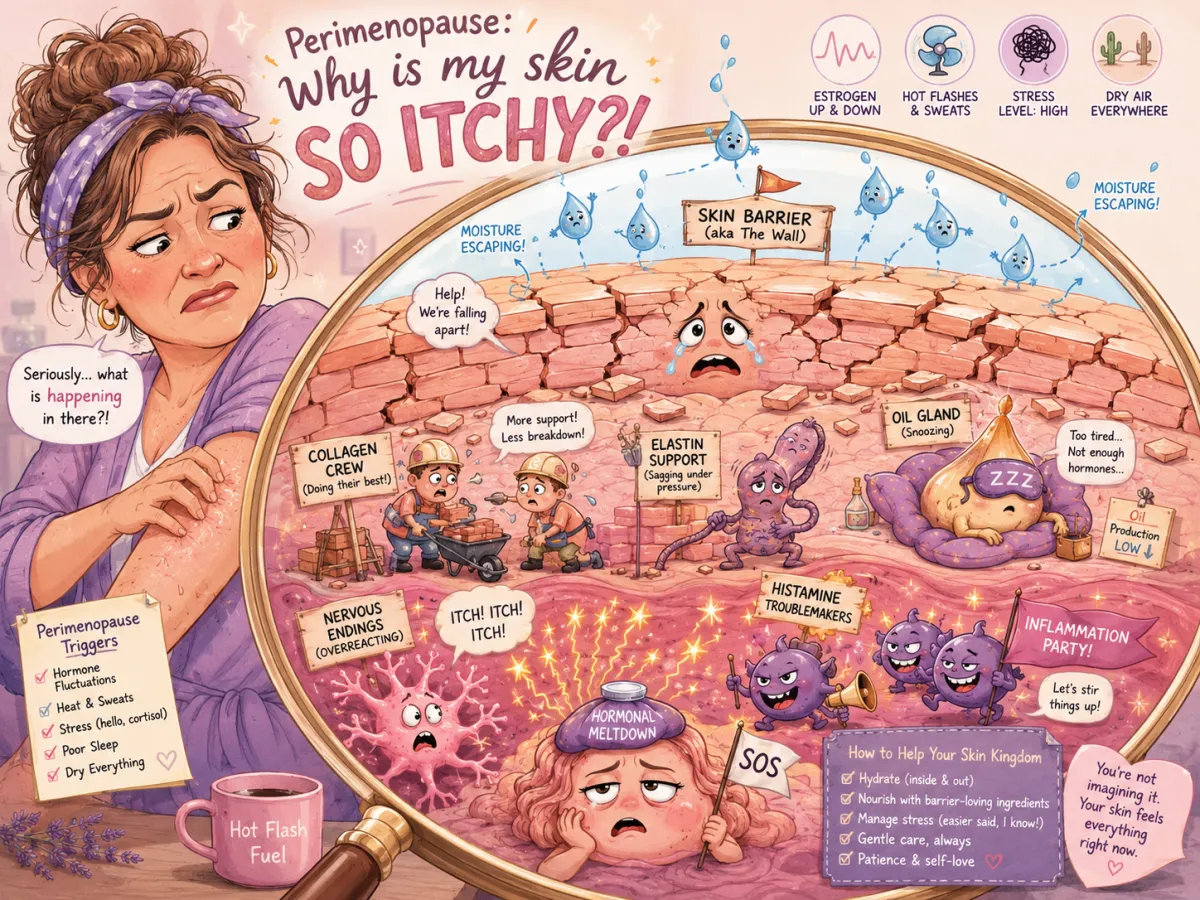
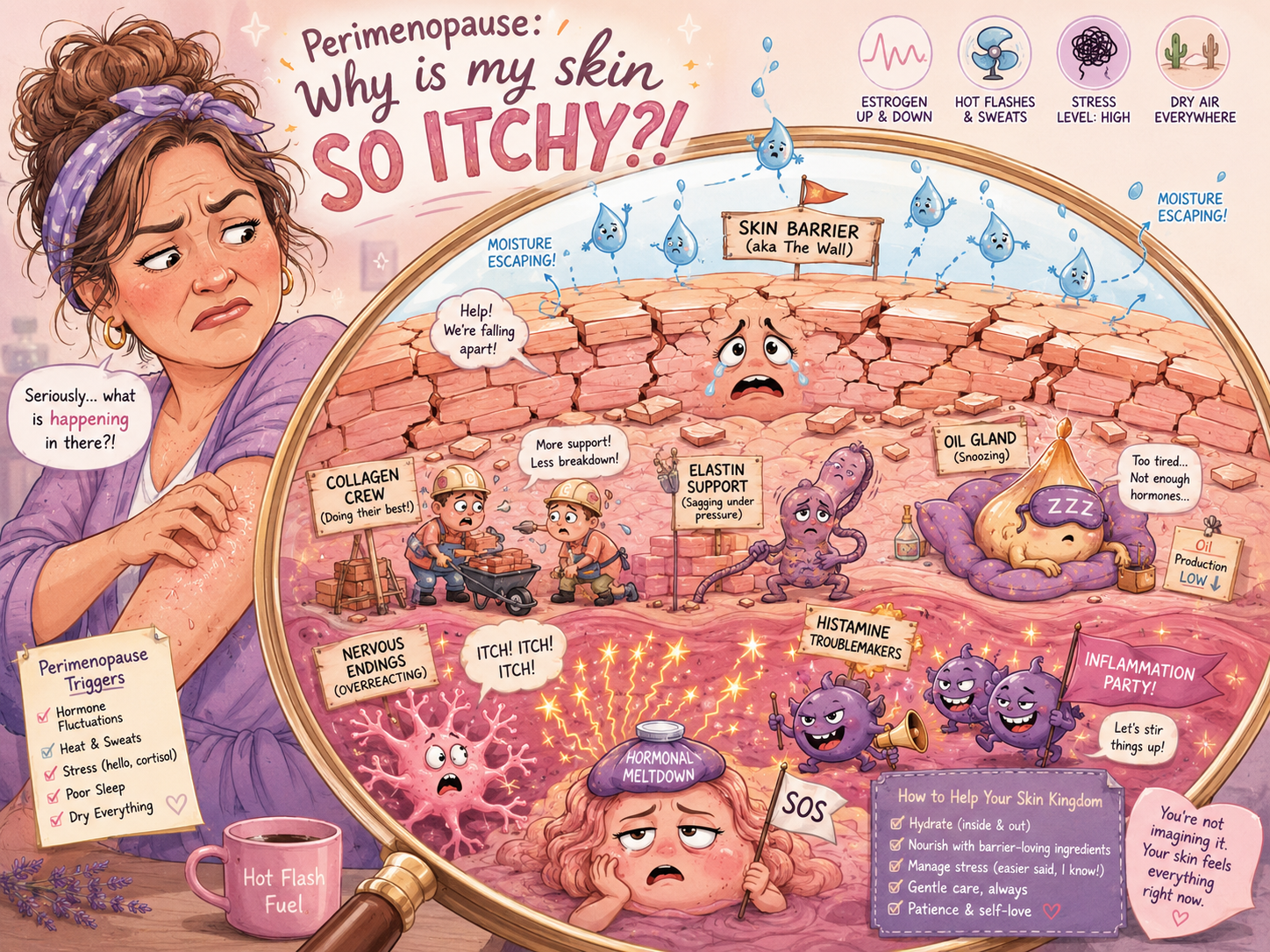
And your skin, the kingdom’s outer wall, starts sending distress signals.
Those distress signals may feel like itching, dryness, burning, prickling, crawling sensations, sensitivity, flaking, redness, or suddenly becoming offended by your favorite lotion.
Let’s talk about why this happens, when to get checked, and how functional health can help calm the kingdom.
Why does itchy skin happen in perimenopause?
The short answer: estrogen changes affect the skin.
The longer answer: your skin is hormonally active tissue. It has estrogen receptors, immune cells, oil glands, nerves, collagen-producing cells, blood vessels, and a barrier system that helps keep moisture in and irritants out.
During perimenopause, estrogen does not simply decline in a straight, polite line. It fluctuates. Some days it may be high, some days low, and some days it behaves like it left the palace and took the keys.
These fluctuations can affect the skin in several ways.
Estrogen helps keep skin hydrated
Estrogen supports the skin’s ability to retain water. When estrogen levels shift or decline, the skin may lose moisture more easily.
That can lead to dryness, tightness, flaking, and itching.
Many women describe it as “my skin feels thirsty no matter what I put on it.”
And yes, sometimes you are drinking water. That does not mean the skin barrier is holding onto it.
Hydration is not just about how much water you drink. It is also about whether your skin can keep that water where it belongs.
Estrogen supports collagen and skin thickness
Collagen is one of the structural proteins that helps skin stay firm, resilient, and supported.
As estrogen changes, collagen production may decrease, and the skin may become thinner, more fragile, and more easily irritated.
This is why some women notice more crepey skin, fine lines, bruising, irritation, or sensitivity during perimenopause and menopause.
The skin barrier becomes a little less “castle wall” and a little more “screen door during a windstorm.”
Still standing, but not quite as protective.
Oil production may decrease
Sebum, your skin’s natural oil, helps protect the skin and reduce water loss.
With hormonal shifts, some women experience less oil production, which can worsen dryness and itching.
This can feel especially confusing if you also get acne during perimenopause.
Because apparently the skin can be dry and break out at the same time.
Perimenopause does not believe in making sense.
Nerve sensitivity can increase
Some women describe perimenopausal itching as prickling, tingling, crawling, burning, or feeling like tiny invisible bugs are walking on the skin.
This sensation is sometimes called formication.
It does not mean bugs are there. It means the nerves in the skin may be more reactive.
Hormonal shifts can influence nerve signaling, skin sensitivity, and how strongly the body perceives itch.
In the royal hormone kingdom, this is like the palace alarm system becoming too sensitive and going off every time a leaf touches the gate.
Histamine and immune reactivity may play a role
Some women notice that perimenopause brings new sensitivities: more itching, flushing, hives, rashes, food reactions, seasonal allergies, or reactions to skincare products.
Estrogen and histamine have a complicated relationship. Hormonal fluctuations may influence mast cells, which are immune cells involved in histamine release.
This does not mean every itchy woman has a histamine disorder.
But it does mean the immune system and hormones are having a conversation, and sometimes that conversation gets loud.
If your skin suddenly reacts to everything, your body may not be “dramatic.” It may be dysregulated.
Stress can make itching worse
Stress does not cause every symptom, and women are tired of being told everything is stress.
But cortisol, the body’s main stress hormone, can affect inflammation, immune function, sleep, blood sugar, and skin barrier repair.
When cortisol is high or your nervous system is chronically activated, itching can feel worse.
Also, itching disrupts sleep. Poor sleep increases stress. Stress worsens inflammation. Inflammation worsens itching.
It is the least fun merry-go-round.
No tickets required.
Blood sugar and inflammation matter too
Insulin resistance and blood sugar swings can contribute to inflammation, oxidative stress, and skin changes.
Some women notice more itching, rashes, yeast issues, slow healing, or skin tags when metabolic health is not optimal.
Again, this does not mean blood sugar is the answer for everyone.
But in functional health, we do not ignore the metabolic kingdom just because the skin is the one yelling.
Your thyroid may be involved
Thyroid dysfunction can cause dry skin, itching, hair changes, fatigue, constipation, cold intolerance, weight changes, menstrual changes, and mood symptoms.
This matters because thyroid symptoms can overlap with perimenopause.
Sometimes women are told, “It is just hormones,” when the thyroid queen has been locked in the tower waving a tiny lab slip.
If itchy, dry skin comes with fatigue, hair shedding, constipation, feeling cold, heavy periods, irregular cycles, or unexplained weight changes, thyroid evaluation may be worth considering.
Gut health and nutrient status can affect skin
The skin is not separate from the gut, immune system, liver, or nutrition.
Nutrient insufficiencies can affect skin repair, barrier function, inflammation, and immune balance. Important nutrients for skin health may include omega-3 fatty acids, vitamin D, zinc, vitamin A, vitamin C, protein, iron, B vitamins, and essential fats.
Gut issues such as constipation, bloating, diarrhea, reflux, or food sensitivities may also contribute to inflammation or nutrient absorption problems.
Your skin is often the kingdom’s announcement board.
Sometimes it posts: “We are dry.”
Sometimes it posts: “We are inflamed.”
Sometimes it posts: “Please send protein and stop surviving on coffee.”
Common ways perimenopausal itching may show up
Itchy skin in perimenopause can look different from woman to woman.
You may notice:
Dry, itchy legs or arms
Itchy breasts or nipples
Itchy scalp
Flaky or sensitive facial skin
Itching that is worse at night
Burning or prickling sensations
Crawling sensations on the skin
New sensitivity to skincare products
Worsening eczema or rosacea
Itching after hot showers
Vaginal or vulvar dryness and itching
More hives or flushing
Skin that feels thin, irritated, or easily scratched
The frustrating part is that your skin may look normal while it feels absolutely ridiculous.
This is common with nerve-related itch, dryness, or early barrier dysfunction.
When should itching be checked by a clinician?
Not all itching is perimenopause.
Please do not assume every symptom is hormonal just because you are in your 40s.
Itching should be medically evaluated if it is severe, persistent, worsening, unexplained, or associated with:
A new rash
Yellowing of the skin or eyes
Dark urine or pale stools
Unexplained weight loss
Fever or night sweats
Severe fatigue
Swelling
Open sores or infection
Itching all over the body without visible dryness
New medications
Known liver, kidney, thyroid, or autoimmune disease
Breast skin changes such as dimpling, redness, scaling of the nipple, nipple discharge, or a new lump
Vulvar itching that does not improve, causes pain, bleeding, skin color changes, fissures, or recurrent symptoms
Sometimes itching is eczema, contact dermatitis, psoriasis, fungal infection, medication reaction, thyroid disease, liver or kidney disease, iron deficiency, diabetes, autoimmune disease, or another dermatologic condition.
Perimenopause may be part of the story, but it should not become a blindfold.
What helps itchy skin during perimenopause?
Let’s start with the practical basics.
Use a gentle, fragrance-free cleanser.
Avoid very hot showers.
Moisturize right after bathing while the skin is still slightly damp.
Choose thicker creams or ointments rather than light lotions if your skin is very dry.
Look for barrier-supporting ingredients like ceramides, glycerin, hyaluronic acid, petrolatum, shea butter, or colloidal oatmeal.
Avoid over-exfoliating.
Avoid harsh retinoids or acids during flares.
Wear breathable fabrics.
Use fragrance-free laundry detergent.
Consider a humidifier if your home is dry.
Do not scratch aggressively, even though I know your inner raccoon wants to.
If there is a rash, inflammation, hives, infection, or severe itching, you may need medical treatment such as topical steroids, antihistamines, antifungals, prescription creams, or dermatology evaluation depending on the cause.
Can HRT help itchy skin?
Hormone therapy may improve some menopause-related skin and vaginal symptoms in appropriately selected women, especially when dryness is part of a broader pattern of menopausal symptoms.
But HRT is not usually prescribed only for itchy skin.
The decision to use hormone therapy should consider the whole picture: hot flashes, night sweats, sleep disruption, vaginal dryness, bone health, personal history, family history, clot risk, breast cancer risk, cardiovascular risk, age, time since menopause, and patient goals.
In the royal hormone kingdom, HRT is not a magic wand thrown from a balcony.
It is a possible royal advisor.
Helpful for some. Not right for everyone. Best used with context.
How functional health helps calm the kingdom
Functional health looks beyond the skin surface and asks: why is the skin irritated, dry, inflamed, reactive, or slow to repair?
It does not replace dermatology or medical evaluation. It adds a deeper layer.
A functional approach may evaluate:
Hormone patterns: estrogen, progesterone, perimenopausal symptoms, cycle changes, sleep, mood, and vasomotor symptoms
Thyroid function: TSH, free T4, free T3, and thyroid antibodies when appropriate
Metabolic health: fasting glucose, fasting insulin, A1c, cholesterol, waist changes, PCOS history, and blood sugar patterns
Inflammation: hs-CRP and other markers when clinically indicated
Nutrient status: vitamin D, ferritin, B12, folate, zinc, omega-3 status, and protein intake when relevant
Gut health: constipation, bloating, reflux, diarrhea, food reactions, microbiome balance, and nutrient absorption
Liver and kidney markers: especially when itching is generalized or unexplained
Stress physiology: cortisol rhythm, sleep quality, nervous system load, and recovery patterns
Skin barrier triggers: products, fragrances, detergents, hot showers, over-exfoliation, and environmental exposures
Histamine patterns: flushing, hives, itching after certain foods, alcohol sensitivity, allergies, or cyclic worsening
The goal is not to blame every itch on hormones.
The goal is to understand the pattern.
Because your skin may be asking for estrogen support, better barrier care, thyroid evaluation, blood sugar regulation, improved nutrient status, gut support, less inflammation, better sleep, or all of the above.
The skin is not being difficult.
It is giving data.
Possibly in the most annoying way available, but still data.
The functional health plan for itchy perimenopausal skin
A thoughtful plan may include:
Supporting protein intake so the body has building blocks for repair
Increasing omega-3-rich foods such as salmon, sardines, chia, flax, and walnuts
Eating colorful plants for antioxidants and polyphenols
Balancing blood sugar with protein, fiber, and healthy fats at meals
Reducing alcohol if it worsens flushing, sleep, histamine symptoms, or dryness
Improving hydration and minerals, not just drinking plain water all day
Correcting vitamin D, iron, B12, zinc, or other nutrient gaps when present
Supporting regular bowel movements
Using a skin barrier repair routine consistently
Addressing sleep disruption and night sweats
Managing stress physiology with realistic nervous system tools
Evaluating thyroid and metabolic markers when symptoms suggest it
Considering HRT or nonhormonal options when appropriate
Referring to dermatology when the skin findings need diagnosis or treatment
This is not about chasing perfection.
It is about restoring order in the kingdom.
Because when estrogen is fluctuating, cortisol is overworked, insulin is causing drama, the thyroid is underappreciated, and the skin barrier guards are exhausted, your body needs strategy.
Not shame.
Not random supplements.
Not another influencer telling you to detox your liver with a tea that tastes like lawn clippings.
Strategy.
A note about vulvar itching
Vulvar itching deserves special attention.
Perimenopause and menopause can cause vulvovaginal dryness, irritation, burning, pain with sex, urinary symptoms, and recurrent discomfort due to changes in estrogen levels.
But vulvar itching can also be caused by yeast, bacterial imbalance, lichen sclerosus, eczema, contact dermatitis, sexually transmitted infections, or other skin conditions.
Please do not keep treating vulvar itching with over-the-counter yeast medication if it keeps coming back or never fully improves.
The vulva is part of the royal kingdom too, and she deserves an actual evaluation, not a guessing game.
The bottom line
Itchy skin in perimenopause is real.
It can happen because estrogen fluctuations affect hydration, collagen, oil production, skin thickness, nerve sensitivity, immune reactivity, and the skin barrier.
But itching is not always “just hormones,” and persistent or severe symptoms should be evaluated.
Functional health can help by looking at the bigger picture: hormones, thyroid, blood sugar, inflammation, gut health, nutrient status, stress, sleep, histamine patterns, and skin barrier triggers.
Your skin is not betraying you.
It is communicating.
Loudly. Repeatedly. Usually at 2:00 a.m.
But with the right evaluation and support, the royal hormone kingdom can become much less chaotic.
The queen may still be in perimenopause.
But at least the castle does not have to itch.
Want a more personalized plan?
Inside my program, we take the confusion out of perimenopause, menopause, hormones, metabolism, inflammation, lifestyle, and long-term prevention. We do not do fear-based medicine. We do not do one-size-fits-all advice. And we definitely do not tell women to just “drink more water and accept suffering as a personality trait.”
You deserve a plan that looks at the whole picture: your symptoms, your labs, your history, your family history, your goals, and your quality of life.
If you are ready for deeper support, you can:
Join my online program for step-by-step education and guidance.
Book a discovery call so we can see whether working together is the right fit.
Join my free communityfor women’s health education, hormone support, and practical lifestyle guidance.
Follow me on Facebook, Instagram, and YouTube for more honest, science-backed conversations about hormones, menopause, functional medicine, and women’s health.
Because you do not need more panic.
You need clarity, strategy, and a clinician who can help you understand your body without making you feel like your hormones came with a warning label and a fog machine.