Is Perimenopause Making Your Joints Feel Like They Just Went Through a Breakup?
Let’s talk about something that does not get nearly enough attention in the perimenopause conversation: joint pain.
Not hot flashes. Not mood swings. Not the sudden urge to reorganize your entire life because someone put the spoon in the wrong drawer.
We are talking about that mysterious “why do my knees sound like a haunted staircase?” situation.
One day you are living your life, walking around like a regular adult. The next day, your hips are giving dramatic main character energy, your shoulders are writing emotional ballads, and your hands feel like they have been personally attacked by a jar of almond butter.
And because women are often handed the deeply unhelpful explanation of “well, you’re getting older,” many of us assume joint pain is just part of the midlife welcome basket.
But no, my friend.
Your body is not being dramatic.
Your hormones are changing, your inflammatory system is shifting, your connective tissue is responding, and your joints are absolutely reading the group chat.
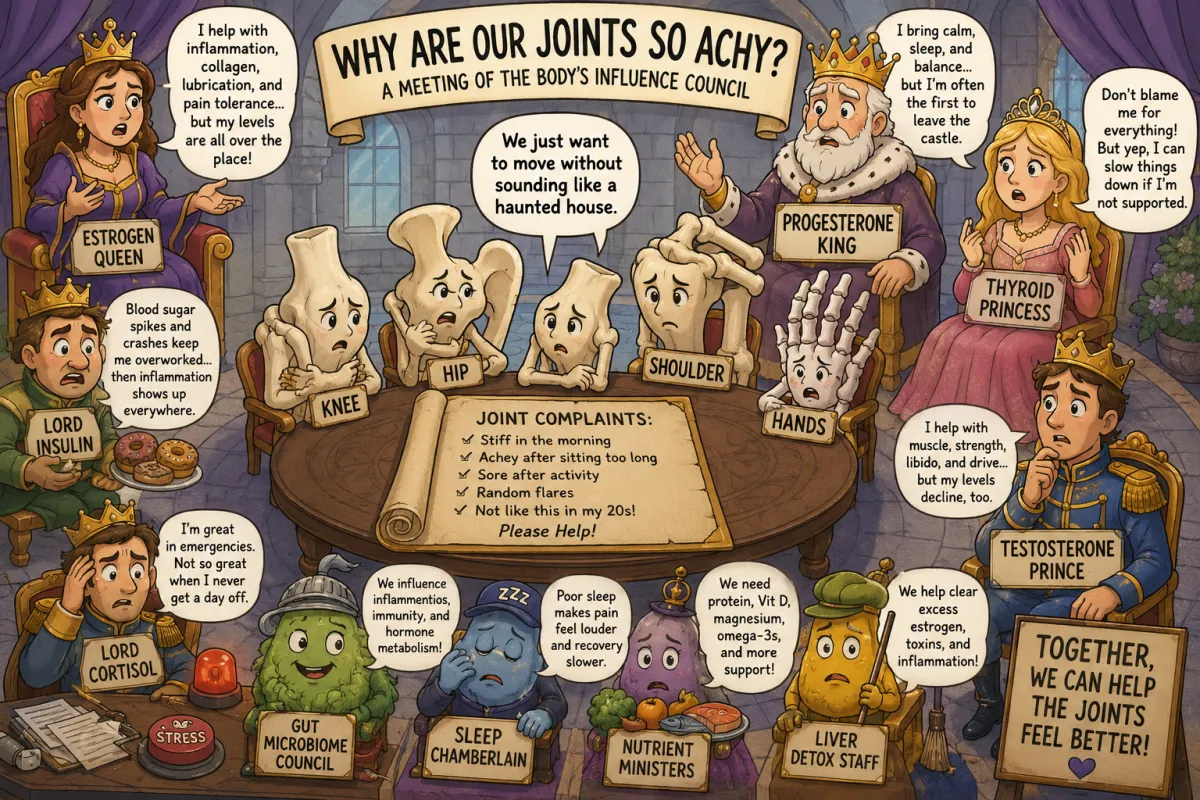
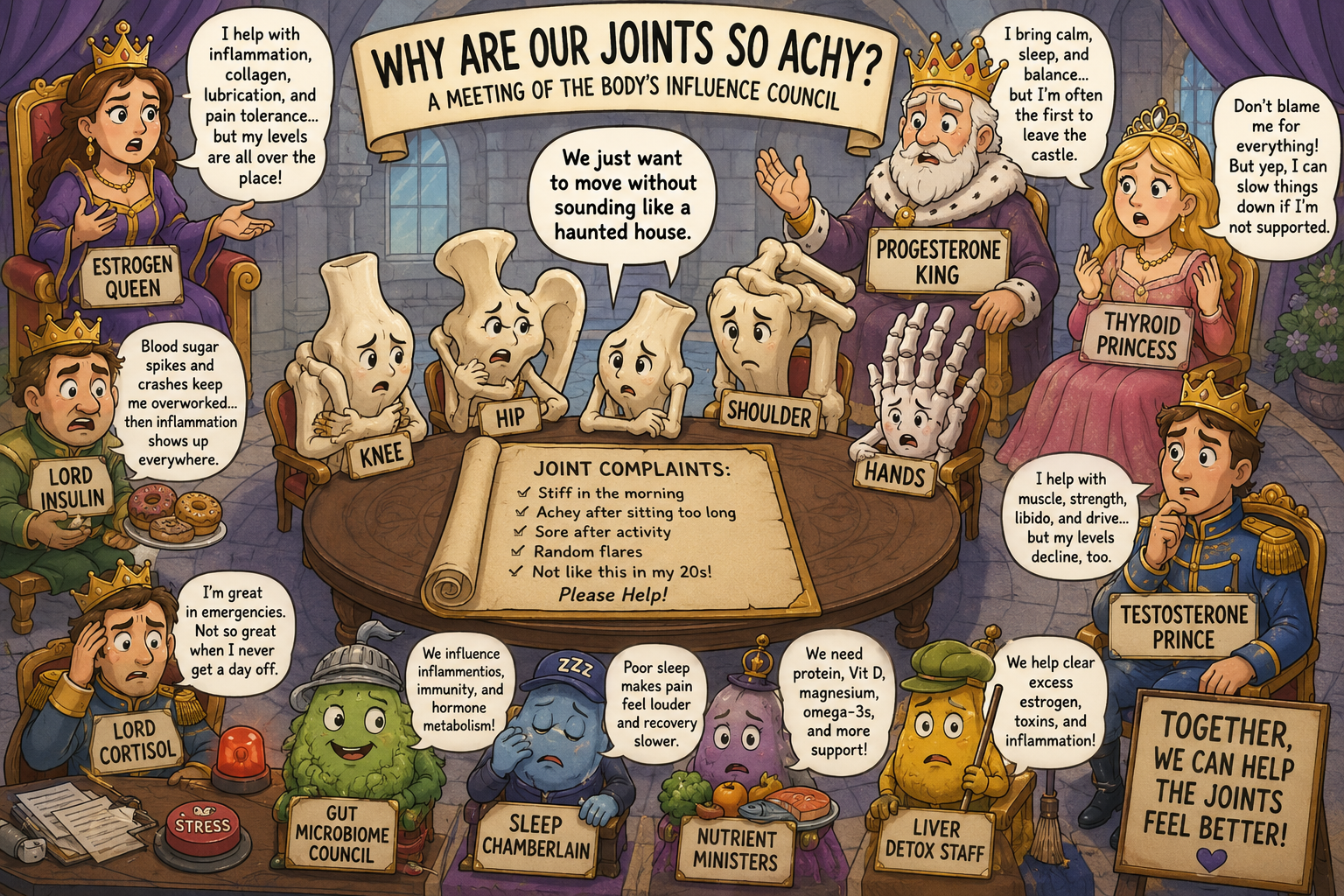
Welcome to the Royal Hormone Kingdom
Imagine your body as a royal kingdom.
For many years, estrogen has been one of the ruling queens. She is not just there to manage periods and fertility. Absolutely not. Estrogen has departments. She has staff. She has influence. She is helping the palace run smoothly.
Estrogen is like the queen of the joint kingdom: part peacekeeper, part collagen contractor, part inflammation bouncer, and part emotional support pop star. When she starts missing meetings in perimenopause, the knees, hips, shoulders, and hands may begin filing formal complaints.
But estrogen does not rule alone.
In this Royal Hormone Kingdom, Princess Thyroid helps govern energy, metabolism, body temperature, bowel function, hair, skin, mood, and the pace of the kingdom. When Princess Thyroid is well-supported, the kingdom feels warm, clear, energized, and alive. When she is struggling, the kingdom can feel cold, tired, constipated, puffy, foggy, and like everything is loading on dial-up internet.
Lord Insulin manages the blood sugar treasury. When he is calm and respected, energy flows steadily through the kingdom. But when he is overworked by constant glucose spikes, skipped meals, poor sleep, stress, and too many naked carbohydrates, he starts causing metabolic drama.
Lord Cortisol is the royal stress advisor. He is useful in emergencies. He gets the kingdom out of bed, helps respond to danger, and keeps everyone alive during a crisis. But when Lord Cortisol is constantly shouting from the tower, the kingdom never gets to rest, repair, sleep deeply, or lower inflammation.
Progesterone is the elegant duchess of calm. She brings softness, sleep support, nervous system steadiness, and emotional balance. When she starts disappearing early in perimenopause, the kingdom may feel more anxious, irritable, wired, sleepless, and less able to tolerate everyone’s nonsense.
Prince Testosterone is the prince of strength, desire, drive, muscle, motivation, confidence, and spark. When he declines or becomes out of balance, women may notice lower libido, less muscle tone, more fatigue, lower motivation, and a general feeling of “where did my fire go?”
And then there is estrogen: queen of the joint kingdom, collagen contractor, inflammation bouncer, mood influencer, bone protector, and keeper of the royal lubrication department.
She helps regulate inflammation.
She supports collagen production.
She helps protect bone density.
She helps maintain muscle mass.
She influences how your brain and nervous system perceive pain.
She helps keep connective tissue, cartilage, tendons, and ligaments more resilient.
In other words, estrogen is not just wearing a crown and waving from a balcony. She is running the whole kingdom with a color-coded spreadsheet, a royal planner, and probably a very strong opinion about everyone staying hydrated.
Then perimenopause begins.
And the royal court gets messy.
Estrogen does not politely retire. She starts acting like a pop star between album eras. Some days she is everywhere. Some days she ghosts you. Some days she returns with full production, backup dancers, pyrotechnics, breast tenderness, and a surprise period you did not invite.
Progesterone, the elegant duchess of calm, often starts quietly leaving the room earlier than expected, which is why sleep, anxiety, mood, and cycle changes may show up before periods fully change.
Princess Thyroid may get blamed for everything, or sometimes she really is part of the problem.
Lord Insulin may become more demanding, especially if sleep is poor, stress is high, muscle mass is dropping, and meals are not balanced.
Lord Cortisol may start acting like he owns the castle.
And Prince Testosterone may not be bringing the same strength, drive, and spark he once did.
This hormonal chaos is one reason perimenopause can feel so confusing. It is not always a clean, steady decline. It is more like an unpredictable world tour with surprise setlists.
Your joints, unfortunately, are in the audience.
Why Joint Pain Happens in Perimenopause
Joint pain during perimenopause is not all in your head.
It is happening in your tissues, your immune system, your nervous system, your muscles, and your inflammatory pathways.
Let’s break it down.
Estrogen Helps Calm Inflammation
Estrogen has anti-inflammatory effects in the body. When estrogen starts fluctuating or declining, the immune system may become more reactive. This can increase inflammatory signals, which may make joints feel stiff, swollen, achy, or tender.
This does not always mean you have arthritis. Sometimes the pain is more functional than structural, meaning the joint may hurt even when imaging does not show major damage.
Very rude, honestly.
It is like your body is sending a fire alarm because someone burned toast. The alarm is real. The symptoms are real. But the building may not actually be on fire.
That is why so many women say, “My labs look normal, but I do not feel normal.”
And they are right to question it.
Collagen Production Changes
Collagen is one of the main structural proteins in your body. Think of it as the scaffolding that helps support your skin, tendons, ligaments, cartilage, fascia, and joint tissue.
Estrogen helps support collagen turnover and tissue elasticity. When estrogen drops, connective tissue may become less hydrated, less elastic, and more vulnerable to stiffness or strain.
This is why some women notice more tendon problems in perimenopause: plantar fasciitis, tennis elbow, hip pain, frozen shoulder, Achilles irritation, or random “why does this body part suddenly have a personality?” moments.
The kingdom’s suspension bridges are losing some maintenance funding.
And suddenly your shoulder is not just a shoulder. It is a whole documentary.
Cartilage and Joint Lubrication Can Be Affected
Cartilage is the smooth cushioning tissue that helps joints glide. Estrogen appears to play a role in cartilage health, joint fluid balance, and tissue repair.
When estrogen becomes less predictable, some women experience more friction, stiffness, and discomfort.
This is why mornings can feel suspicious.
You get out of bed and your ankles need a warm-up act.
The first ten steps of the day should not require negotiations, but here we are.
Muscle Mass Starts Shifting
During midlife, women become more prone to losing muscle mass, especially if they are not doing regular resistance training.
And muscle is not just for looking toned in sleeveless tops.
Muscle protects joints.
Muscle improves insulin sensitivity.
Muscle supports metabolism.
Muscle stabilizes your hips, knees, spine, and shoulders.
Muscle helps you get off the floor without making sound effects.
When muscle mass declines, joints may absorb more stress. That can make everyday activities feel harder. Stairs become personal. Squats become political. Getting up from a chair becomes a full congressional hearing.
This is not weakness.
This is physiology.
But here is the good news: it is also very trainable.
Pain Sensitivity Can Increase
Hormones affect the nervous system.
Estrogen interacts with neurotransmitters and pain-modulating pathways. When estrogen fluctuates, some women become more sensitive to pain.
Now add poor sleep, stress, blood sugar swings, low magnesium, low vitamin D, thyroid imbalance, gut inflammation, or elevated cortisol, and your nervous system may start acting like every minor ache deserves a ten-minute emotional bridge.
Your body is not broken.
It may just be amplifying the volume.
The Taylor Swift Version: Your Joints Are Entering a New Era
Perimenopause is not one symptom.
It is an era.
Your joints may be in their “Anti-Hero” era, whispering, “It’s me, hi, I’m the problem, it’s me.”
Your sleep may be in its “Midnights” era.
Your mood may be in its Reputation era, especially if someone suggests you “just relax.”
Your metabolism may be in its Folklore era: mysterious, moody, and living in the woods.
And estrogen?
Estrogen is on a surprise acoustic set schedule. No one knows what she is playing tonight.
Meanwhile, Progesterone, the elegant duchess of calm, is backstage trying to keep everyone from sending emotionally charged text messages at midnight.
Lord Cortisol is demanding an emergency meeting.
Lord Insulin is reviewing the snack choices.
Princess Thyroid is asking why everyone keeps blaming her.
And Prince Testosterone is somewhere trying to remember where he put the motivation, muscle tone, and libido.
But here is the good news: you are not powerless in this era.
You do not have to accept joint pain as your new personality trait.
You do not have to say, “Well, I guess this is just my life now,” while slowly lowering yourself into a chair like a Victorian widow.
This is where a functional medicine lens can be incredibly helpful.
How Functional Medicine Looks at Perimenopause Joint Pain
Conventional medicine often asks, “Is there a disease?”
That is important.
We absolutely want to rule out rheumatoid arthritis, lupus, thyroid disease, significant osteoarthritis, inflammatory bowel disease-related arthritis, medication side effects, injury, and other medical conditions.
But functional medicine also asks, “Why is this system irritated?”
That question matters.
Because perimenopause joint pain is often not just about one hormone. It can be the result of several systems losing harmony at the same time.
In the Royal Hormone Kingdom, estrogen may be the queen of the joint kingdom, but she is not ruling alone.
Princess Thyroid helps govern energy, metabolism, temperature, bowel function, hair, skin, mood, and the pace of the kingdom.
Lord Insulin manages blood sugar, metabolic flexibility, cravings, belly fat storage, inflammation, and whether your energy feels steady or chaotic.
Lord Cortisol is the royal stress advisor, responsible for survival, alertness, and emergency response, but deeply disruptive when he refuses to clock out.
Progesterone is the elegant duchess of calm, helping support sleep, mood steadiness, nervous system resilience, and cycle balance.
Prince Testosterone supports muscle, motivation, libido, confidence, strength, and that subtle inner spark women are often told not to care about, but absolutely do.
And then there is the gut microbiome council, the liver detoxification staff, the nutrient ministers, and the sleep chamberlain, who frankly may have been underperforming lately.
Everyone is trying to keep the kingdom from becoming a chaotic medieval group project.
Functional medicine looks at the whole court.
The Usual Suspects Behind Achy Perimenopause Joints
Blood Sugar Swings
Insulin resistance becomes more common during perimenopause and menopause.
When blood sugar rises and falls dramatically, inflammation may increase. This can worsen joint pain, fatigue, cravings, belly weight gain, brain fog, and that “why am I tired and wired at the same time?” feeling.
In kingdom terms, Lord Insulin is tired.
He has been managing the blood sugar treasury for years. But when meals are unbalanced, sleep is poor, stress is high, and muscle mass is declining, Lord Insulin has to work overtime.
At first, he tries to keep things organized.
Then he starts yelling.
Then the treasury gets chaotic.
And suddenly, energy crashes, cravings rise, belly fat becomes more stubborn, and inflammation starts acting like it paid rent.
A breakfast of coffee and vibes may have worked in your twenties.
In perimenopause, your body may prefer protein, fiber, and actual nourishment.
She has standards now.
Cortisol and Stress
Cortisol is your main stress hormone.
In small amounts, it is useful. It gets you out of bed, helps you respond to challenges, and keeps you alive.
But chronically elevated cortisol can worsen inflammation, disrupt sleep, increase muscle tension, impair recovery, and contribute to blood sugar dysregulation.
Translation: if your life is constantly giving emotional damage world tour, your joints may feel it.
Lord Cortisol is excellent in a crisis. We love him when there is an actual emergency.
But Lord Cortisol was never meant to run the kingdom 24 hours a day.
When he refuses to clock out, the body can stay in survival mode. Sleep becomes lighter. Blood sugar becomes more reactive. Muscles become tighter. Recovery slows. Inflammation becomes louder.
This does not mean your pain is “just stress.”
It means stress biology is real biology.
Poor Sleep
Sleep is when your body repairs tissue, regulates inflammation, balances hunger hormones, restores nervous system tone, and supports immune function.
When perimenopause disrupts sleep, pain often gets louder.
This creates a vicious cycle: pain disrupts sleep, poor sleep increases pain sensitivity, and then you wake up feeling like you were assembled incorrectly overnight.
Progesterone, the elegant duchess of calm, often plays a role here.
As progesterone declines or becomes more unpredictable in perimenopause, many women notice more anxiety, lighter sleep, night waking, premenstrual mood changes, and that very special 3 a.m. meeting with every regret they have ever had.
Sleep is not lazy.
Sleep is repair.
Sleep is medicine.
Sleep is the kingdom’s night-shift maintenance crew.
Low Vitamin D, Magnesium, Omega-3s, or Protein
Nutrients matter.
Vitamin D supports bone, muscle, and immune function.
Magnesium supports muscle relaxation, sleep, and nervous system regulation.
Omega-3 fats help support a healthier inflammatory balance.
Protein provides the amino acids needed for muscle and connective tissue repair.
You cannot build a strong palace out of iced coffee, crackers, and resentment.
And listen, we have all tried.
But eventually the body files a complaint.
The nutrient ministers need supplies. The collagen contractors need materials. The muscle builders need protein. The nervous system needs minerals. The bones need vitamin D, strength training, and actual support.
This is not about perfection.
It is about giving your body what it needs to do the job you are asking it to do.
Gut Health
The gut microbiome influences inflammation, immune regulation, estrogen metabolism, and nutrient absorption.
If the gut is inflamed, constipated, dysbiotic, or irritated by certain foods, systemic inflammation may rise.
This does not mean everyone needs a restrictive diet. It does not mean you need to fear gluten, dairy, tomatoes, joy, or every food that has ever appeared on the internet.
It means the gut deserves a seat at the royal table.
The gut microbiome council is involved in more than digestion. It helps communicate with the immune system, supports nutrient absorption, influences inflammatory balance, and participates in estrogen metabolism.
When the gut is unhappy, the entire kingdom hears about it.
The goal is not food fear.
The goal is food intelligence.
Thyroid Dysfunction
Low thyroid function can cause muscle aches, joint pain, stiffness, fatigue, weight gain, constipation, dry skin, hair thinning, cold intolerance, and low mood.
Sound familiar?
Exactly.
Princess Thyroid and perimenopause symptoms can overlap like two exes showing up at the same wedding.
Sometimes Princess Thyroid is innocent and unfairly blamed.
Sometimes she really is part of the problem.
That is why testing matters.
Guessing is not a strategy.
Testosterone Changes
Testosterone is often thought of as a “male hormone,” but women need testosterone too.
Prince Testosterone supports muscle, motivation, libido, drive, confidence, strength, and overall vitality.
When testosterone declines or becomes less available, some women notice they feel softer, weaker, less motivated, less interested in sex, more fatigued, or just less like themselves.
This can indirectly affect joint pain because muscle matters. Less muscle means less joint support, less metabolic flexibility, and less resilience.
Prince Testosterone is not here to turn you into someone else.
He is here to help you feel like you have some spark, strength, and agency in your own body.
What You Can Do About It
Now for the part we actually care about: how do we help your body feel better?
Strength Train Like It Is Your Midlife Medicine
If I could put one intervention in a crown, it would be strength training.
Resistance training supports muscle mass, joint stability, bone density, insulin sensitivity, metabolism, posture, and long-term independence.
It is one of the most powerful tools for perimenopause and menopause.
You do not need to become a bodybuilder. You do not need to flip tires in a parking lot unless that brings you joy.
Start with two to three days per week.
Focus on the major movement patterns: squat, hinge, push, pull, carry, and core stability.
Muscle is your joint’s best friend.
Honestly, muscle is the friend who shows up with soup, receipts, and a plan.
Prince Testosterone appreciates this. Lord Insulin appreciates this. Princess Thyroid appreciates this. Your bones appreciate this. Your knees may not send a thank-you card immediately, but they are listening.
Keep Moving, Even When You Feel Stiff
Joint stiffness often improves with gentle movement.
Walking, mobility work, yoga, Pilates, swimming, cycling, and stretching can all help.
The goal is not punishment.
The goal is circulation, lubrication, and nervous system regulation.
Motion is lotion.
Yes, it sounds like something your aunt would say, but she is right.
Movement tells the kingdom, “We are safe. We are alive. We are still participating.”
Prioritize Protein
Many women are under-eating protein, especially at breakfast.
In perimenopause, protein becomes more important for muscle maintenance, blood sugar stability, tissue repair, metabolism, and satiety.
A good target for many women is roughly 25 to 35 grams of protein per meal, adjusted for body size, kidney health, activity level, and medical context.
Think eggs, Greek yogurt, cottage cheese, fish, chicken, turkey, tofu, tempeh, lentils, beans, lean meats, protein smoothies, or whatever fits your preferences, culture, and lifestyle.
Your joints are not asking for perfection.
They are asking for building blocks.
The collagen contractors cannot build with air.
The muscle team cannot work with wishes.
The kingdom needs supplies.
Eat in a Way That Calms Inflammation
An anti-inflammatory eating pattern does not have to be dramatic.
It usually means more colorful plants, fiber, omega-3-rich foods, herbs, spices, high-quality protein, and fewer ultra-processed foods.
Helpful staples include berries, leafy greens, olive oil, salmon, sardines, chia seeds, flaxseeds, walnuts, beans, lentils, turmeric, ginger, and plenty of fiber.
This is not about diet culture.
This is about giving the kingdom better construction materials.
Food is not just calories.
Food is information.
It tells your immune system, gut, hormones, blood sugar, and mitochondria what kind of kingdom they are living in.
Stabilize Blood Sugar
Build meals around protein, fiber, and healthy fats.
Avoid starting the day with naked carbohydrates, meaning carbohydrates without protein, fat, or fiber to slow the glucose response.
For example, instead of toast alone, try toast with eggs or avocado and smoked salmon.
Instead of oatmeal alone, add protein powder, Greek yogurt, chia, nuts, or hemp seeds.
Instead of a smoothie that is basically fruit juice in a wellness costume, add protein, fiber, and fat.
Blood sugar stability can reduce cravings, improve energy, support mood, and potentially lower inflammatory load.
Basically, Lord Insulin would like a calmer era.
And honestly, he deserves one.
Support Cortisol Instead of Worshiping Stress
Stress management does not mean pretending life is easy.
It means teaching the body that it is not in constant danger.
This may include morning light, walking, breathwork, prayer, meditation, boundaries, therapy, journaling, strength training, better sleep routines, reducing overcommitment, and learning that not every text message requires an immediate emotional response.
Lord Cortisol needs a job description.
He can help with emergencies.
He cannot be allowed to run the whole castle.
Check the Labs That Matter
A functional medicine workup for joint pain in perimenopause may include:
Hormone patterns when appropriate
Thyroid panel
Vitamin D
B12
Ferritin and iron studies
Inflammatory markers
Fasting insulin and glucose
A1c
Lipid markers
Autoimmune screening when symptoms suggest it
Markers of liver and kidney function
Nutrient status when clinically indicated
Testing should be personalized.
The goal is not to order every lab known to humanity.
The goal is to stop guessing.
Because when you understand what is happening in the kingdom, you can stop blaming yourself and start building a strategy.
Consider Hormone Therapy When Appropriate
Menopausal hormone therapy may help some women with perimenopausal and menopausal symptoms, and it may support bone protection when prescribed appropriately.
It is not for everyone.
It depends on your personal history, family history, timing, symptoms, risk factors, and goals.
But for many healthy women in the appropriate window, it is worth a thoughtful, evidence-based conversation.
Hormones are not a magic wand.
But sometimes restoring order to the kingdom requires addressing the queen who left the castle lights flickering.
And that conversation should be individualized, evidence-based, and free of fear.
Support Recovery
Your body cannot heal in a constant state of emergency.
Recovery includes sleep, rest days, nervous system regulation, hydration, stress reduction, sunlight, connection, and not treating your body like it is an underperforming employee.
This may be the least glamorous part of the plan, but it is often the most needed.
Your joints do not only need movement.
They need repair.
The kingdom does not rebuild during chaos.
It rebuilds during recovery.
When Joint Pain Is Not “Just Hormones”
Perimenopause can contribute to joint pain, but not all joint pain is hormonal.
Please get evaluated if you have:
Significant joint swelling
Red, hot, or visibly inflamed joints
Severe morning stiffness lasting more than an hour
Unexplained fever
Rash
Sudden weakness
Unexplained weight loss
Pain after injury
Joint deformity
Symptoms that are rapidly worsening
Pain that consistently wakes you from sleep
A family history of autoimmune disease with concerning symptoms
We do not blame everything on hormones.
That would be lazy medicine.
Hormones are important, but they are not a diagnostic junk drawer.
The goal is not to dismiss symptoms.
The goal is to understand them.
The Bottom Line
If your joints started aching in perimenopause, you are not falling apart.
You are changing.
Your estrogen is shifting. Your inflammation pathways may be more reactive. Your collagen, cartilage, tendons, muscles, and nervous system may all be adjusting to a new hormonal landscape.
Princess Thyroid may need evaluation.
Lord Insulin may need steadier blood sugar.
Lord Cortisol may need boundaries.
Progesterone, the elegant duchess of calm, may need support.
Prince Testosterone may need attention.
Your gut, liver, nutrients, sleep, muscles, and stress system may all be part of the story.
But this is not the end of the story.
With strength training, smart nutrition, blood sugar balance, better sleep, stress support, targeted labs, gut and thyroid evaluation when needed, and thoughtful hormone conversations, many women can feel dramatically better.
Perimenopause is not your body betraying you.
It is your body asking for a new strategy.
And yes, maybe your knees are currently singing a breakup ballad.
Maybe your hips are in their dramatic bridge.
Maybe your shoulder has entered its tortured poet era.
But with the right support, this can also become your comeback era.
The kingdom can be rebuilt.
The queen can be negotiated with.
The princess can be evaluated.
The lords can be given boundaries.
The duchess can be invited back into the room.
The prince can find his spark again.
And you, my friend, are not done dancing.
Want a More Personalized Plan?
If this topic made you think, “Wait… I need someone to help me make sense of my hormones, my family history, my symptoms, and my actual risk,” that is exactly why I created my online program.
Inside my program, we take the confusion out of perimenopause, menopause, hormones, metabolism, inflammation, lifestyle, and long-term prevention.
We do not do fear-based medicine.
We do not do one-size-fits-all advice.
And we definitely do not tell women to just “drink more water and accept suffering as a personality trait.”
You deserve a plan that looks at the whole picture: your symptoms, your labs, your history, your family history, your goals, and your quality of life.
If you are ready for deeper support, you can join my online program for step-by-step education and guidance.
You can book a discovery call so we can see whether working together is the right fit.
You can join my free community for women’s health education, hormone support, and practical lifestyle guidance.
And you can follow me on Facebook, Instagram, and YouTube for more honest, science-backed conversations about hormones, menopause, functional medicine, and women’s health.
Because you do not need more panic.
You need clarity, strategy, and a clinician who can help you understand your body without making you feel like your hormones came with a warning label and a fog machine.
Join me and Lets Flourish and Bloom together