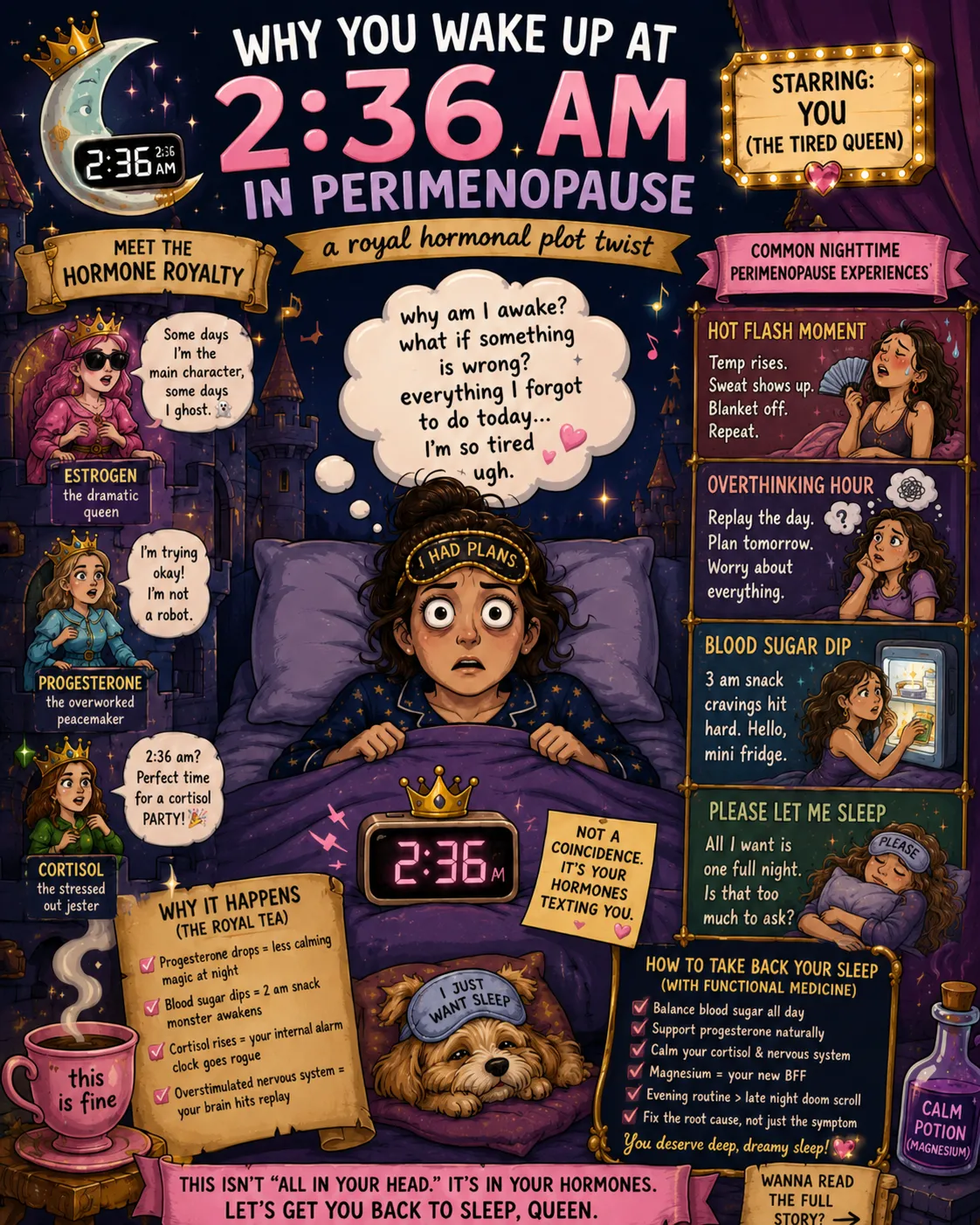
Waking Up at 2:36 AM in Perimenopause: When the Hormonal Kingdom Pulls the Fire Alarm
There is a very specific kind of betrayal that happens when you wake up in the middle of the night, look at the clock, and it says 2:36 AM.
Not 2:00.
Not 3:00.
2:36.
Suspiciously specific.
Your body is wide awake like it has urgent palace business. Your brain suddenly wants to review every decision you have made since 1998. Your heart may be racing. You may be hot, sweaty, anxious, hungry, annoyed, or all of the above.
Meanwhile, your rational mind is whispering, “We have a full day tomorrow. Please return to sleep.”
And your perimenopausal body replies, “Interesting proposal. Denied.”
If this is happening to you, you are not alone. Sleep disruption is one of the most common and frustrating symptoms of perimenopause. It may happen because of night sweats, hot flashes, anxiety, stress, blood sugar changes, bladder symptoms, or sleep disorders, but it can also happen even without obvious hot flashes.
So let’s talk about why you may be waking up at 2:36 AM, what is happening inside the hormonal kingdom, and how functional health can help restore order.
Perimenopause: The Era Tour Nobody Bought Tickets For
Perimenopause can feel like an unexpected Era Tour, except instead of cute outfits and friendship bracelets, you get irregular periods, hot flashes, mood swings, itchy skin, brain fog, and a surprise 2:36 AM wake-up call.
One night your body is in its “hot flash era.”
The next night it is in its “why am I anxious?” era.
Then comes the “I need to pee but barely” era.
Then the “I am exhausted but wide awake” era.
Then the “why is my heart beating like I just ran from a bear?” era.
The goal is not to cancel the whole tour.
The goal is to understand which era your body is in, what is driving the symptoms, and how to support the kingdom so every night does not become a sold-out performance of insomnia.
Welcome to the royal hormone kingdom after midnight
In the royal hormone kingdom, estrogen used to help keep the palace steady.
She supported temperature regulation, serotonin, mood, sleep quality, vaginal and urinary health, and the general feeling of “I can handle my life without emotionally negotiating with my pillow.”
Progesterone was the calm royal advisor. She helped support GABA, the brain’s calming neurotransmitter system, and often helped the body feel more settled.
Melatonin was the night watchman, gently dimming the palace lights.
Cortisol was supposed to rise in the morning, not burst into the throne room at 2:36 AM wearing boots and carrying a clipboard.
Then perimenopause arrives.
Estrogen starts fluctuating.
Progesterone becomes less predictable, especially when ovulation becomes irregular.
Hot flashes may begin sneaking through the palace hallways.
Blood sugar may become more dramatic.
The bladder starts sending unnecessary notifications.
The nervous system guards become jumpy.
And suddenly, the entire kingdom is awake at 2:36 AM asking, “Are we in danger, or did we just have wine and not enough protein?”
Sometimes the answer is yes.
Why does perimenopause mess with sleep?
Perimenopause is not just “low estrogen.”
It is fluctuating estrogen.
This matters because the brain loves rhythm. Sleep depends on rhythm. Your temperature regulation depends on rhythm. Cortisol, melatonin, insulin, and reproductive hormones all work best when the kingdom has predictable timing.
During perimenopause, the rhythm gets messy.
Your ovaries may ovulate some months and not others. Progesterone may be lower or inconsistent. Estrogen may spike, drop, surge, disappear, and reappear like a queen who refuses to use the shared calendar.
The result can be lighter sleep, more awakenings, night sweats, early morning waking, anxiety, palpitations, and that very rude 2:36 AM “why am I awake?” moment.
The temperature control center gets dramatic
One of the biggest reasons women wake up at night in perimenopause is vasomotor symptoms: hot flashes and night sweats.
Your hypothalamus is the part of the brain that helps regulate body temperature. Think of it as the palace thermostat.
When estrogen fluctuates, the thermostat can become oversensitive. A tiny change in body temperature may trigger the body to dump heat.
So at 2:36 AM, your body may decide:
“Too hot. Open the windows. Activate sweat. Increase heart rate. Wake the queen.”
You may wake up drenched, flushed, panicky, chilled afterward, or suddenly furious at your blanket.
This is not because your blanket betrayed you.
It is because your thermostat has entered its villain era.
Progesterone: the missing sleep advisor
Progesterone is often associated with a calming effect in the nervous system.
In regular ovulatory cycles, progesterone rises after ovulation. But in perimenopause, ovulation can become irregular. If ovulation is inconsistent, progesterone may be inconsistent too.
This matters because progesterone metabolites interact with GABA pathways, which help the brain feel calm.
In the hormone kingdom, progesterone is the advisor who says:
“Everyone lower your voice.”
“No, we are not solving taxes at 2:36 AM.”
“The meeting about childhood regrets is canceled.”
When progesterone becomes unreliable, the brain may feel more wired, anxious, restless, or prone to early waking.
This is why some women feel exhausted but alert.
Tired but awake.
Sleepy but suspicious.
A body that wants sleep, with a brain that opened a courtroom.
Cortisol: the 2:36 AM palace intruder
Cortisol is supposed to follow a daily rhythm. It should be lower at night and gradually rise toward morning.
But chronic stress, poor sleep, blood sugar swings, alcohol, inflammation, overtraining, under-eating, and nervous system overload can disrupt that rhythm.
When cortisol rises too early, you may wake up suddenly and feel:
Alert
Anxious
Hungry
Hot
Restless
Mentally busy
Like you need to check your phone, which is almost always a mistake
In the royal hormone kingdom, cortisol is the overworked manager who knocks on your bedroom door at 2:36 AM saying:
“Quick question. Have we considered every possible future disaster?”
No, cortisol.
We have not.
And we will not be doing that tonight.
“You Need to Calm Down,” Said No Helpful Nervous System Ever
Telling a perimenopausal woman to “just calm down” at 2:36 AM is like telling a smoke alarm to be more positive.
Technically nice.
Completely useless.
If your nervous system is activated, it may not be because you are choosing anxiety. It may be because your body is responding to a real internal signal: a hot flash, a cortisol spike, a blood sugar dip, poor sleep architecture, alcohol, stress overload, thyroid imbalance, or progesterone doing a disappearing act.
Functional health does not just tell the kingdom to calm down.
It asks why the palace alarms are going off in the first place.
The Taylor Swift Version: Your Sleep Is in Its “Anti-Hero” Era
If perimenopause had a soundtrack at 2:36 AM, it would absolutely include an “Anti-Hero” moment.
Your body wakes up suddenly.
Your heart is racing.
Your brain is overthinking.
Your blanket is somehow too hot and too cold.
And your nervous system is standing in the hallway saying, “Maybe I’m the problem.”
But here’s the truth: you are not the problem. Your sleep system is dysregulated.
Your estrogen is fluctuating. Progesterone, the calming royal advisor, may be missing its night shift. Cortisol may be arriving too early with a clipboard and an attitude. Blood sugar may be dipping. Hot flashes may be sneaking through the palace like tiny hormonal arsonists.
So no, you are not broken.
Your body is just in a very dramatic album cycle.
Blood sugar: the midnight plot twist
Blood sugar is one of the most overlooked reasons for waking in the middle of the night.
If your blood sugar drops during the night, your body may release cortisol and adrenaline to bring it back up. That stress response can wake you.
You may wake up at 2:00 to 4:00 AM feeling anxious, sweaty, shaky, hungry, or alert.
This is especially common if dinner was light, protein was low, alcohol was involved, stress was high, or you had a blood sugar rollercoaster earlier in the day.
Your body may not be having an emotional crisis.
It may be asking for metabolic stability.
This is why waking at 2:36 AM after wine, dessert, skipped meals, or a chaotic day can feel like your nervous system is auditioning for a thriller.
The kingdom does not need a lecture.
It may need protein, fiber, minerals, and less glucose drama.
Alcohol: the sleep thief wearing cute shoes
Alcohol can make you feel sleepy at first, but it often disrupts sleep later in the night.
It can worsen night sweats, increase heart rate, fragment sleep, alter blood sugar, reduce REM sleep, and trigger early morning waking.
This is deeply unfair because alcohol often arrives socially dressed as “a relaxing glass of wine.”
But in perimenopause, wine may take off the cute outfit around 2:36 AM and reveal itself as a tiny sleep goblin with a tambourine.
Not every woman needs to avoid alcohol completely, but if you are waking at the same time every night, alcohol deserves a performance review.
Anxiety: the midnight committee meeting
Perimenopause can increase anxiety in some women because estrogen and progesterone influence neurotransmitters involved in mood, calm, and stress resilience.
If sleep becomes lighter, anxiety has more room to sneak in.
And nighttime anxiety is special because there are no normal daytime distractions. No emails. No errands. No people asking what is for dinner.
Just you and your brain.
Which is unfortunate, because the 2:36 AM brain is not known for balanced perspective.
It says things like:
“Remember that awkward thing you said in 2009?”
“What if you never sleep again?”
“Should we reorganize the pantry?”
“Is this perimenopause, or are we dying?”
This is not wisdom.
This is a sleep-deprived nervous system with access to memory.
The bladder also joins the group chat
Estrogen changes can affect the urinary tract and vaginal tissues.
Some women wake more often to urinate, feel more bladder urgency, or develop genitourinary symptoms in perimenopause and menopause.
If you are waking to pee every night, it may not just be “I drank too much water.”
It may be related to hormone changes, pelvic floor issues, bladder irritants, blood sugar, sleep apnea, or other medical causes.
In the kingdom, the bladder is the messenger who knocks at the worst possible time:
“My queen, I bring urgent news.”
“What is it?”
“Three drops.”
Unnecessary.
Sleep apnea and restless legs should not be missed
Not every perimenopause sleep problem is hormonal.
Women can develop or worsen obstructive sleep apnea, restless legs syndrome, insomnia disorder, anxiety disorders, thyroid problems, reflux, pain, medication-related sleep disruption, and other conditions during this stage.
Sleep apnea can occur even in women who do not fit the stereotypical picture. It may show up as snoring, waking up gasping, morning headaches, dry mouth, fatigue, brain fog, high blood pressure, or waking frequently without knowing why.
Restless legs can be associated with low iron stores and can make sleep feel impossible.
This is why functional health does not stop at “it’s hormones.”
Hormones may be involved, but they may not be acting alone.
What does waking at 2:36 AM mean?
The exact time is usually not magical.
I know. Disappointing.
Waking at 2:36 AM does not automatically mean your liver is detoxing, your cortisol is broken, your ancestors are calling, or Mercury is in your pancreas.
It usually means your sleep is being disrupted during the second half of the night, when sleep can become lighter and the body is more vulnerable to temperature shifts, cortisol changes, blood sugar dips, bladder signals, stress chemistry, and environmental triggers.
So yes, the time may feel oddly specific.
But the cause is usually a pattern, not a prophecy.
How functional health helps
Functional health asks: why is the body waking up?
Not just “how do we sedate it?”
There is a difference.
A functional approach looks at the full kingdom:
Hormones
Blood sugar
Cortisol rhythm
Thyroid function
Nutrient status
Gut health
Inflammation
Alcohol and caffeine timing
Sleep environment
Hot flashes and night sweats
Stress load
Nervous system regulation
Bladder symptoms
Sleep apnea risk
Medication and supplement timing
This is not about making sleep complicated.
It is about finding the actual levers.
Because if the problem is night sweats, the plan is different.
If the problem is blood sugar dips, the plan is different.
If the problem is anxiety, the plan is different.
If the problem is sleep apnea, the plan is very different.
And if the problem is that your phone is basically a glowing anxiety rectangle beside your bed, we should discuss that too.
The “Shake It Off” Strategy, But Make It Functional Medicine
I love the idea of “shaking it off,” but at 2:36 AM, most women are not casually dancing through their symptoms.
They are lying there with one leg out of the blanket, one leg under the blanket, sweating, freezing, mentally reviewing a conversation from 2014, and wondering if sleeping three hours counts as a lifestyle.
So yes, we want to shake off the cycle of waking, worrying, clock-checking, and spiraling.
But functional medicine asks what needs to be supported so the body can actually do that.
Do we need to stabilize blood sugar?
Support progesterone?
Treat night sweats?
Reduce alcohol?
Move caffeine earlier?
Check thyroid function?
Correct low iron, B12, vitamin D, or magnesium?
Calm inflammation?
Evaluate sleep apnea?
Teach the nervous system that 2:36 AM is not a royal emergency?
That is the difference between “just relax” and an actual plan.
Functional testing that may help
Testing should be personalized, not a random royal treasure hunt.
Depending on symptoms, history, and goals, helpful evaluation may include:
Thyroid testing: TSH, free T4, free T3, and thyroid antibodies when appropriate. Thyroid imbalance can cause insomnia, anxiety, palpitations, temperature intolerance, and fatigue.
Metabolic testing: fasting glucose, fasting insulin, hemoglobin A1c, and sometimes a continuous glucose monitor. This can help identify blood sugar swings that may contribute to nighttime waking.
Iron and ferritin: low iron stores can contribute to restless legs, fatigue, palpitations, and poor sleep.
Vitamin B12, folate, vitamin D, magnesium status, and other nutrients when clinically relevant.
Hormone evaluation: cycle pattern, ovulation history, progesterone timing, estrogen patterns, and perimenopause symptoms. In perimenopause, symptoms and patterns often tell more than one random hormone snapshot.
Cortisol rhythm assessment when clinically useful, especially when there is waking with alertness, anxiety, burnout, or disrupted sleep-wake timing.
Inflammation markers when indicated.
Gut health evaluation when bloating, reflux, constipation, diarrhea, food reactions, or suspected malabsorption are part of the picture.
Sleep evaluation when snoring, gasping, morning headaches, daytime sleepiness, resistant insomnia, restless legs, or frequent unexplained waking are present.
Again, the goal is not to test everything.
The goal is to stop guessing.
What can help tonight?
Some practical steps may help reduce those 2:36 AM wakeups.
Eat a balanced dinner with protein, fiber, and healthy fat.
Avoid going to bed underfed.
Limit alcohol and see whether sleep improves.
Move caffeine earlier in the day.
Keep the bedroom cool.
Use breathable bedding and pajamas.
Create a consistent wind-down routine.
Avoid doom-scrolling before bed.
Get morning light exposure.
Avoid intense late-night exercise if it wakes you up.
Consider a small protein-rich bedtime snack if nighttime waking feels blood-sugar related.
Manage hot flashes and night sweats medically when needed.
Do not check the clock repeatedly. The clock is not your friend at 2:36 AM. It is a tiny judge with numbers.
If you wake up, try not to start a full mental committee meeting. Keep lights low, avoid your phone, and use a boring, repetitive calming practice.
Boring is the goal.
Your brain does not need a TED Talk at 2:36 AM.
It needs fewer witnesses.
Can hormone therapy help sleep?
For some women, yes.
If sleep disruption is driven by hot flashes, night sweats, and other perimenopausal symptoms, hormone therapy may help when appropriate. It is considered the most effective treatment for bothersome vasomotor symptoms, including hot flashes and night sweats.
Some women may also benefit from nonhormonal medications, CBT-I, targeted supplements, treatment of sleep apnea or restless legs, thyroid support, blood sugar stabilization, or stress physiology work.
HRT is not a sleeping pill.
It is one possible tool when hormone-related symptoms are a major driver.
In the royal kingdom, HRT may help bring the queen back into council.
But we still need to check who else is causing chaos in the hallway.
The functional medicine sleep plan
A thoughtful plan may include:
Identifying whether wakeups are linked to night sweats, anxiety, blood sugar, bladder symptoms, alcohol, caffeine, or stress
Stabilizing blood sugar through meal timing and protein intake
Reducing alcohol if it triggers early waking
Supporting progesterone and estrogen balance when clinically appropriate
Treating hot flashes and night sweats
Checking thyroid, iron, B12, vitamin D, glucose, insulin, and inflammation when indicated
Evaluating for sleep apnea or restless legs when symptoms fit
Supporting gut health and nutrient absorption
Creating a realistic sleep routine
Reducing nervous system activation before bed
Using CBT-I strategies when insomnia becomes conditioned
Considering HRT or nonhormonal options when appropriate
This is not about chasing perfect sleep.
It is about teaching the kingdom that nighttime is not the time for emergency meetings.
When to seek medical help
Please seek medical evaluation if sleep disruption is severe, persistent, worsening, or associated with:
Chest pain
Fainting
Severe shortness of breath
New neurological symptoms
Severe depression or suicidal thoughts
Heavy or abnormal bleeding
Drenching night sweats unrelated to menopause symptoms
Unexplained weight loss
Fever
Snoring, gasping, or pauses in breathing during sleep
Severe anxiety or panic
Restless legs symptoms
Frequent urination, burning, pain, or blood in the urine
Perimenopause can explain a lot.
It should not be used to dismiss everything.
The bottom line
Waking up at 2:36 AM in perimenopause is not random, and you are not broken.
Your hormones may be fluctuating. Your thermostat may be dramatic. Progesterone may be missing its calming shift. Cortisol may be arriving too early. Blood sugar may be dipping. Alcohol may be stealing sleep. Your bladder may be sending unnecessary memos. Your nervous system may be overactivated.
In the royal hormone kingdom, the palace is not cursed.
It is dysregulated.
Functional health helps by looking at the whole picture: hormones, thyroid, blood sugar, cortisol rhythm, nutrients, gut health, inflammation, sleep environment, hot flashes, stress, and possible sleep disorders.
The goal is not just to knock you out.
The goal is to understand why your body keeps waking you up.
Because you deserve sleep that feels like restoration, not a nightly hostage negotiation.
And if your body insists on waking you at 2:36 AM, we can at least stop letting cortisol run the palace meeting.
Want a more personalized plan?
Inside my program, we take the confusion out of perimenopause, menopause, hormones, metabolism, inflammation, lifestyle, and long-term prevention. We do not do fear-based medicine. We do not do one-size-fits-all advice. And we definitely do not tell women to just “drink more water and accept suffering as a personality trait.”
You deserve a plan that looks at the whole picture: your symptoms, your labs, your history, your family history, your goals, and your quality of life.
If you are ready for deeper support, you can:
Join my online program for step-by-step education and guidance.
Book a discovery call so we can see whether working together is the right fit.
Join my free community for women’s health education, hormone support, and practical lifestyle guidance.
Follow me on Facebook, Instagram, and YouTube for more honest, science-backed conversations about hormones, menopause, functional medicine, and women’s health.
Because you do not need more panic.
You need clarity, strategy, and a clinician who can help you understand your body without making you feel like your hormones came with a warning label and a fog machine.